Before you pay anyone, write down three things: when the water shows up, where it first appears, and what sits above that spot outside. Those answers separate rain, groundwater, indoor humidity, plumbing and sewer backup, and each of those has a different fix. The two sources we lean on most, University of Minnesota Extension (UMN) and Building Science Corporation (BSC), point the same way. UMN’s order is moisture made indoors, then gutters, downspouts and grading, and only then a drainage system. BSC says to look above grade first and calls fixing a wet foundation without fixing surface problems possibly futile. Our guides to why basements get wet go deeper on each cause.
This page is the sorting step. It gives you two tables to read your leak against, four checks that cost little or nothing, and what to do at each ending. Lowest Floor sells and installs nothing and refers no one, so none of this leads to a quote.
Stop here if any of these is true
- There is standing water and the power is on. Do not go in. Iowa Health and Human Services says to shut off the electricity before entering a flooded basement, preferably at the meter, and to call the utility if you can’t do that safely. If you would have to walk through water to reach the panel, that means calling the utility (our reading). Iowa also says to turn off the gas valves. Start with what to do first in a flooded basement.
- Water is coming up through a floor drain, toilet or tub. Treat it as sewage unless someone shows otherwise. FEMA's urban flooding guide lists floor drains, toilets and sinks as the places sewage comes back in. Keep people and pets away, and read what to do when a floor drain backs up.
- A wall has a horizontal crack, or leans or bows. Call a structural engineer before you do anything else, including the hose test below. See horizontal cracks in a basement wall.
When does the water show up?
Timing is your cheapest clue. BSC says to sort a wet foundation by how often it gets wet (close to constant, or seasonal) and by where, for example next to wet soil or a disconnected downspout. Neither BSC nor UMN publishes a timing chart, though. The table below is our reading of how each source of water behaves, with a source named where one says so. It points you to a next check and doesn’t settle anything on its own.
| When it happens | Points toward | Next check |
|---|---|---|
| During rain, or soon after, and it stops when the weather clears | Roof or surface water reaching the soil against the wall | Walk the outside in the rain (below), then water after heavy rain |
| During a thaw | Snowmelt. A builder-trade checklist on the National Association of Home Builders site treats it like rain. BSC shows refrozen roof runoff piling up against a foundation | Same walk, looking at where the melt runs and pools |
| For days or weeks in wet seasons | Rising groundwater. UMN says the water table can rise with flooding or the seasons, and BSC lists rising groundwater among seasonal causes, alongside spring and fall rains | Fix the surface water first, then see whether it persists |
| All year, even in dry spells | Groundwater or a plumbing leak | Water meter check |
| On humid summer days with no rain, on cool walls and floors | Condensation. UMN says many homeowners take this for a leak | Plastic sheet check |
| When the washer, shower or dishwasher runs | A leaking pipe, or a drain that can’t carry the water away | Stop using water and call a plumber. If it comes up a drain, go to the sewage ending below |
| When the lawn sprinklers run | Irrigation, which the home builders’ checklist asks about specifically | Turn them off for a week and compare |
| In a new house, as a general dampness | Moisture leaving new concrete. UMN says it can take many months or years to settle | Plastic sheet check |
Where does it first appear?
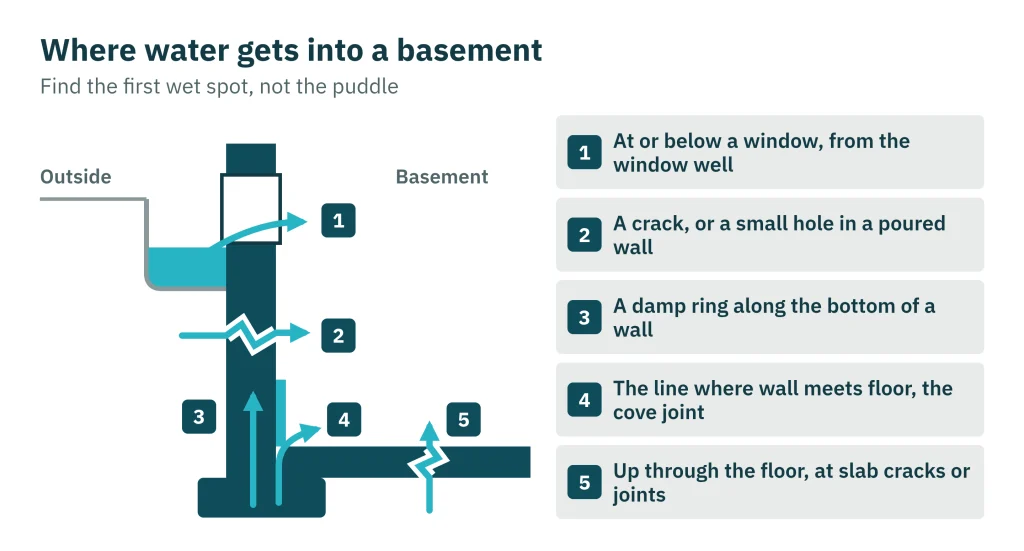
Find the first wet spot, not the puddle. Water runs along the floor to the lowest point, so the puddle is often far from the entry. Check right after the water starts, with a flashlight, and take a dated photo.
| Where you see it | What it can mean | Read next |
|---|---|---|
| Drops or a film spread across a wall, on cold pipes, on the floor | Condensation. EPA ties moisture on walls and pipes to high indoor humidity | Musty smell and damp air |
| A damp ring along the bottom of a wall, with no running water | Capillary suction. UMN says water wicks up through the footing and slab and that this is very common at cold joints. BSC describes the same path at the footing-to-wall joint | Plastic sheet check |
| Running out along the line where wall meets floor | Installers call this the cove joint. BSC explains that water piled up against a foundation pushes through any joint, flaw or crack it can find | Leaking basement walls |
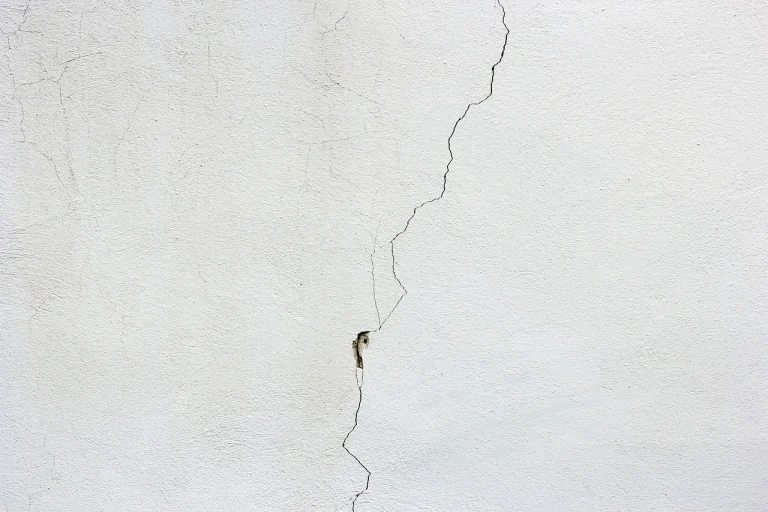
| From a crack, or a small hole in a poured wall | BSC shows seepage at form-tie holes and through a poured wall after rain. A crack’s look alone doesn’t tell you whether it’s structural | Cracks in basement walls |
| Up through the middle of the floor, at slab cracks or joints | BSC warns that gravel under the slab that isn’t connected to the drainage system can build pressure and flood through joints in the slab | Water coming through the floor |
| At or below a window | UMN calls window wells a drain right next to the wall. FEMA notes that windows close to the ground let surface water in | Leaking basement windows |
| At the top of a wall, or from the ceiling | Our reasoning: water starting that high didn’t rise through the soil at floor level. Think pipes, a bathroom above, or the ground sitting too high. The home builders’ checklist asks that the ground be at least 6 inches below the top of the foundation wall | Water meter check, then the outside walk |
| Around the water heater, a water tank, humidifier, dishwasher or washer | The home builders’ checklist lists all of these as leak sources | Dry the floor and watch that spot |
| The sump pit is overflowing | UMN notes that the pump can fail and that drain tile can clog or collapse. An overflowing pit means water is reaching the pit faster than it’s leaving | Sump pump not working |
| White crust on the wall | BSC calls efflorescence a sign of moisture: mineral salts carried by water. It shows that water has moved here, even if the wall is dry today | Note the spot and watch it in the next rain |
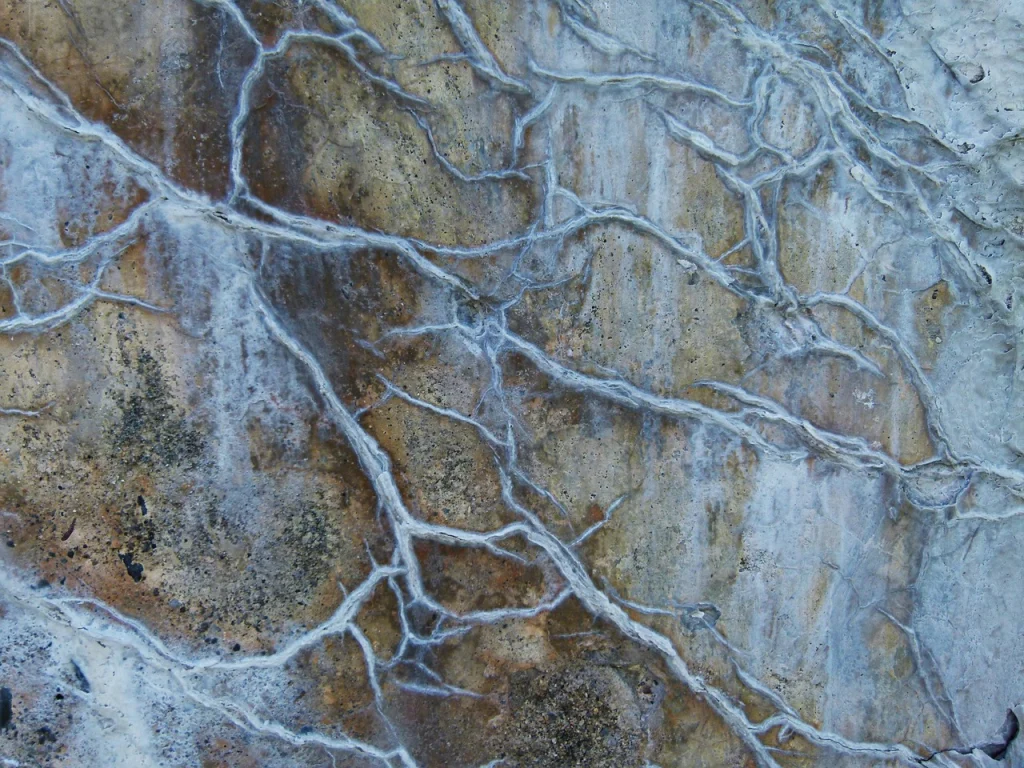
Don’t judge by how the water looks. We found no health agency, EPA page or extension service that gives a look or smell test for sewage. Clear water isn’t proof of clean water. In our reasoning, where it came up tells you more than its color.
Finished walls change the search. BSC warns that finishes can hide water for long periods, sometimes until the damage is extensive. Stains, blistering and odor (all on UMN’s symptom list) mean you may have to open a small area to see the wall itself.
Four checks to run yourself
1. Walk the outside in the rain
BSC says above-grade drainage is the first place to look, and FEMA’s home checklist agrees: next time it rains, watch where the runoff goes. Go around the house with your phone during a real downpour, though not in a thunderstorm. Look for:
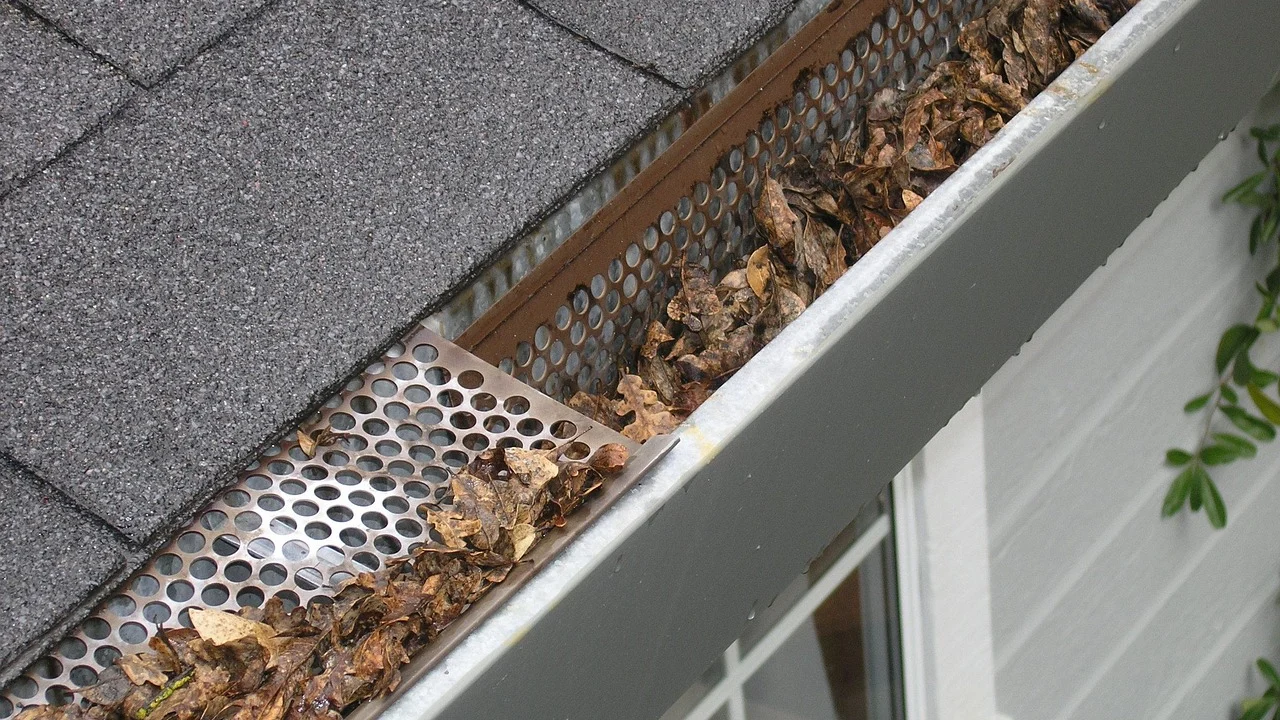
- Gutters spilling over, and downspouts that end at the wall. UMN says a downspout with no extender or splash block is worse than no downspout, because it drops the roof’s water in one spot by the basement.
- Ground that is level or tilts toward the house. Fill next to a foundation often settles, and UMN singles out the area under stoops.
- Roof valleys and corners, seen from the ground. BSC shows one roof that sent about a quarter of its rain to a 6-foot stretch.
- Window wells, outside basement stairs and low doors holding water.
- Water arriving from a neighbor’s lot, or irrigation hitting the foundation.
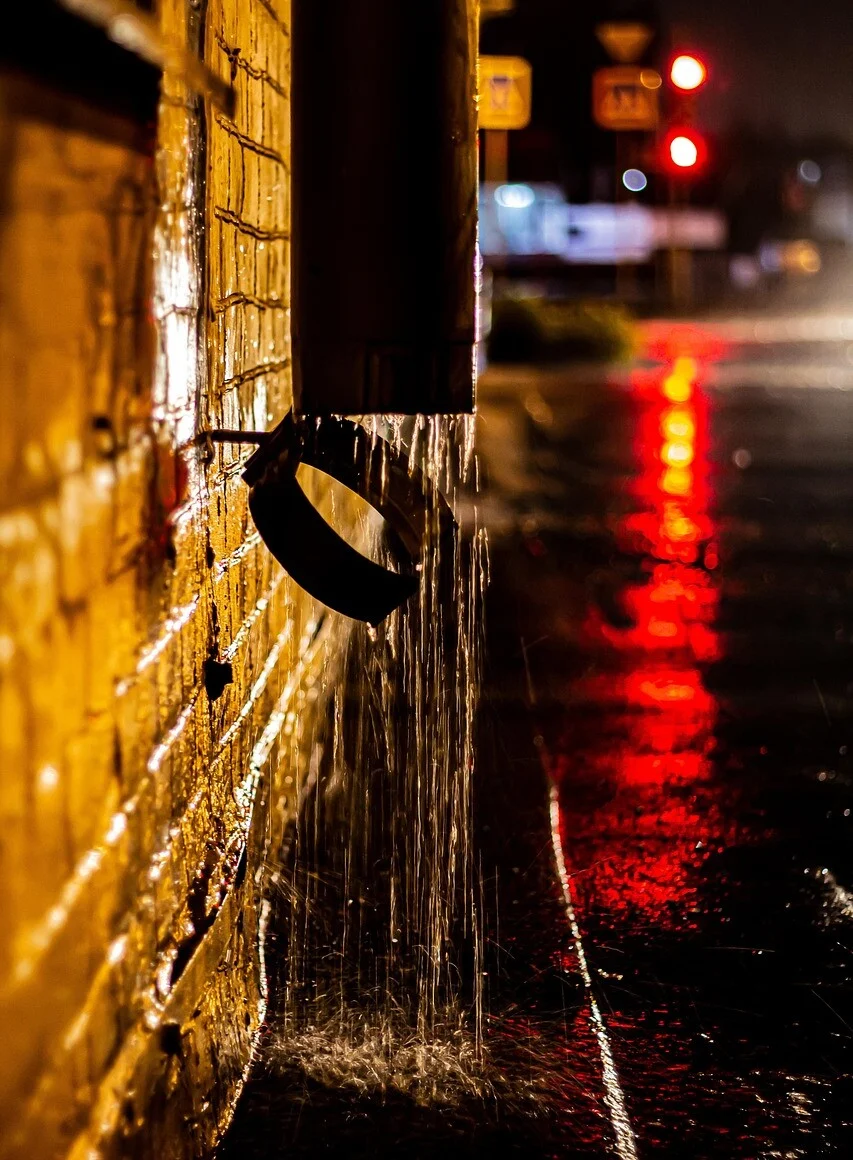
Match what you see to the inside. A wet spot under a spilling gutter corner is the kind of lead BSC describes. FEMA’s checklist also says to take notes and photographs as you go, and those help later with an insurer or a contractor.
2. The plastic sheet check
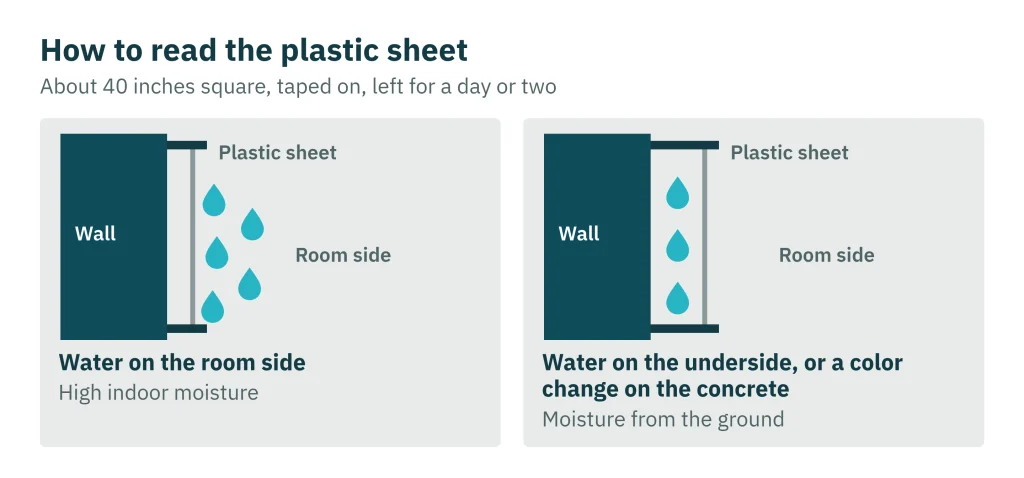
This one separates humidity from ground moisture. Natural Resources Canada says to tape a sheet of plastic about 40 inches square to the wall or floor and leave it for a day or two. Water on the room side means high indoor moisture. Water on the underside, or a change of color on the concrete, means moisture coming from the ground. We found no US extension source for this test, so we credit the Canadian government. It reads dampness. It tells you nothing useful about a spot that is running with water.
3. The water meter check
EPA's WaterSense program says to read your meter before and after two hours with no water in use. If the reading changes at all, you probably have a leak. Turn off anything that uses water on its own, such as a softener, an ice maker or irrigation.
Know what this does and doesn’t cover (our reasoning, not EPA’s). A moving meter shows a leak somewhere on the supply side, which may be a running toilet and not the basement. A still meter clears the pressurized supply pipes only. A leaking drain won’t show, because the meter doesn’t see water leaving the house. If you are on a well with no meter, this check isn’t available to you.
4. The hose test
Waterproofing contractors use this, and none of the government or extension sources we read describes it, so treat it as trade practice. There is no standard for it that we could find. With someone watching inside, run a hose gently on the ground beside one suspect spot. Start low and work along the wall, one section at a time. As of November 2026, some contractors’ pages suggest about 20 minutes per spot, and say a leak at the wall-floor line can take an hour or more to show. Those are rules of thumb, not tested figures.
A leak that appears tells you a lot. A dry result doesn’t clear the spot, since one hose isn’t a storm. Skip this test if a wall is cracked horizontally or bowing, or if the soil is already saturated, because that adds water where you don’t want it (our advice).
Keep a log while you do this
Note the date, the rain, the spot, how much water, and a photo. Date the end of any crack in pencil. EPA's moisture guide, written for larger buildings, advises watching for changes in existing cracks and for new ones. Two storms’ worth of notes gives an engineer or contractor more to work with than a single dry-day visit.
Where your answers lead
Indoor humidity or condensation
UMN puts this first because it’s the cheapest. Vent clothes dryers and bathrooms, remove humidifiers, and don’t open basement windows on warm, humid days. A dehumidifier can reduce the humidity and odor, but UMN says it isn’t a permanent fix, and that in a basement with a real water problem it can draw moisture in faster. Next: work out a dehumidifier size only after the plastic sheet says the moisture is in the air.
A plumbing leak
Call a plumber. If the leak is a supply pipe and you can reach the main valve safely, shut it off. Dry the area right away: EPA says to dry water-damaged areas within 24 to 48 hours to prevent mold.
Sewer backup
Stop using water, stay out of it, and call your sewer utility or a plumber. FEMA notes that a blockage in your own lateral (the pipe from the house to the sewer) can back sewage up even when the public sewer is flowing, and that the lateral is usually the owner’s to maintain. Cleanup follows EPA's archived Hurricane Sandy sheet of November 2012, read on 4 November 2026: rubber gloves, boots, goggles and an N-95 mask. EPA’s mold guide says damage from sewage or contaminated water needs an experienced professional, and our mold page covers that guidance.
Rain or surface water
Fix gutters, downspouts and grading before spending anything larger. The next section has the numbers, and UMN says those repairs may solve the problem.
Groundwater, or water that survives those fixes
BSC is plain that groundwater can still get in on a well-graded, well-drained site. That is when drainage earns its cost. See the fixes in order for what comes next, and the table below for what each repair is meant to do.
A wall that may be moving
FEMA says cracks could show damage from earth pressure on the outside of the wall, that some older homes have unreinforced walls that can buckle or collapse, and that the fixes usually need an architect, engineer or experienced contractor. North Dakota State University Extension lists horizontal cracking and walls out of plumb as signs of buckling. Texas guidelines from the American Society of Civil Engineers say most cracks don’t compromise structural integrity, and that seeing a warning sign doesn’t by itself mean a foundation is failing. They also say an engineer has to weigh the crack, and they were written for Texas homes, mostly on slabs and pier-and-beam foundations. No public source we read gives a width or direction that makes a crack safe, so a structural engineer who isn’t selling the repair is the right call. Our sister site CostPlain breaks down what foundation repair costs.
How to fix it, in order
UMN’s advice is to do the easy, low-cost things first and control the source of the water, not stop it at the last line of defense. Its steps:
- Remove or vent indoor moisture sources.
- In summer, stop ventilating with humid outside air.
- Correct gutters, downspouts and grading.
- If the problem persists, add an interior or exterior drainage system.
BSC reaches the same place. It says many problems can be solved with grading and surface drainage, and that without first fixing surface problems, correcting a wet foundation “might be futile”. Roof water also shouldn’t be sent into the ground next to the house, and especially not into the foundation drain.
The numbers differ, so here they all are
| Source | Ground slope | Downspout discharge |
|---|---|---|
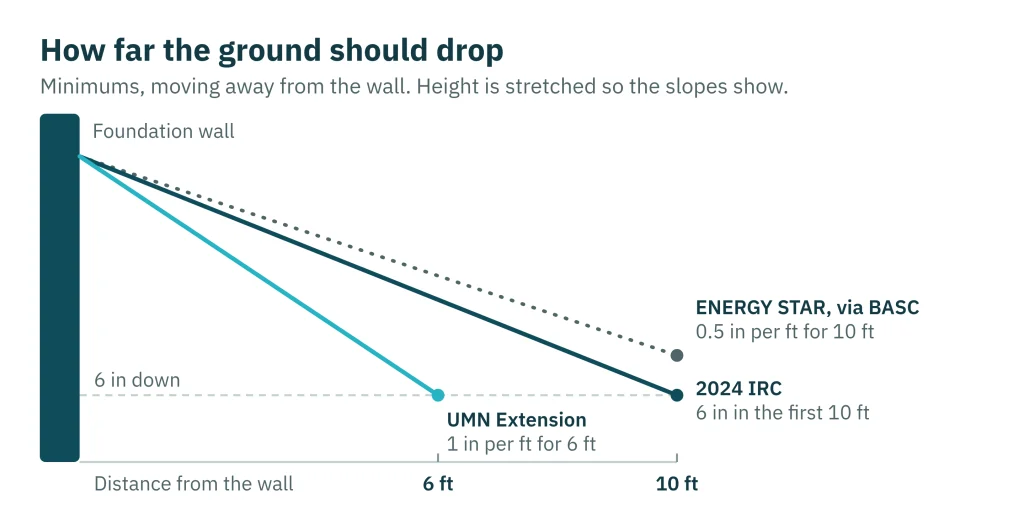
| 2024 IRC R401.3 (model code) | At least 6 inches of fall in the first 10 feet; hard surfaces within 10 feet slope at least 2%. Drains or swales where a barrier prevents the slope | No figure |
| UMN Extension | At least 1 inch per foot for at least 6 feet | At least 4 feet beyond the wall; at least one downspout per 50 feet of eave |
| ENERGY STAR, as reported by BASC | At least 0.5 inch per foot for 10 feet, on permeable surfaces (a new-home program) | No figure |
| EPA Indoor airPLUS, as reported by BASC | No figure | At least 5 feet, to sloped ground, or an underground catchment at least 10 feet out, not tied to the foundation drain |
The IRC and UMN both ask for about 6 inches of drop, but UMN wants it within 6 feet instead of 10. We read the last two rows on the Department of Energy’s BASC site, not in the programs’ own documents. The IRC is a model code, so check your local adoption. Our grading calculator compares your measured drop with each figure.
Why it matters: UMN says a 1-inch rain puts about 1,250 gallons on a 2,000 sq ft roof. USGS's figure of 27,154 gallons per acre-inch gives 1,247. With four downspouts sharing it evenly (our assumption), each carries about 312 gallons. In Chicago, NOAA's Atlas 14 puts a 10-year, one-hour storm at 2.08 inches, which is about 2,593 gallons off the same roof in an hour. That’s a point estimate for one place, not a forecast. Try your own roof in the runoff calculator.
Basement leak repairs compared
Use this table to check that a proposed repair matches the cause you found. Effectiveness percentages on sales pages have no study behind them that we could find, so there are none here.
| Repair | Meant for | Limits the sources state |
|---|---|---|
| Gutters, extensions, regrading | Roof and surface water | May not be enough for groundwater. BSC says groundwater issues can still occur on a properly graded and drained site |
| Sealing a crack | Water coming through a known crack | A horizontal crack or a bowing wall goes to a structural engineer first. FEMA says specialty contractors usually do this work and can also check that the wall can resist the pressure outside. UMN says drainage usually handles water at cracks, though repair may be necessary |
| Interior coating or membrane | Damp walls | UMN calls these temporary: the water stays, and they deteriorate or send it elsewhere |
| Dehumidifier | Humidity and odor | UMN says it treats symptoms and can draw moisture in faster in a wet basement |
| Interior drain and sump | Water at the wall-floor line and under the slab, when outside work isn’t practical | BSC: the fallback in renovations. UMN says a channel above the slab can leave humidity and mold and can’t drain groundwater from under the slab, and that a below-slab pipe is the most effective interior option |
| Exterior drainage and waterproofing | Stopping groundwater before it reaches the wall | UMN: the most costly and most effective. BSC: always preferable to interior drainage where it’s practical. BSC adds that dampproofing, the usual coating on foundations, typically can’t withstand significant water pressure |
Don’t finish or insulate first. BSC and UMN both say to control the water before covering the walls.
Before you sign anything
Installers may be right about your basement, but the firm that inspects is often also the firm that sells. Texas engineers’ guidelines ask evaluating engineers to avoid conflicts of interest, and a sales inspection isn’t independent in that sense. Wisconsin goes further. Its consumer protection agency says waterproofing sellers there must give you a “seller’s analysis” of the water problem and the methods and materials before you finalize a contract (a signed, written statement, under state code ATCP 110.09, read in Justia’s copy), must put guarantees in writing, and can sell pressure pumping only with an engineer’s analysis given to you before the sale. That rule binds sellers only in Wisconsin, but it makes a good list anywhere:
- What does the quote say the cause is, in writing?
- What did they check to find it: when it leaks, where, and which test?
- Did they look at gutters, downspouts and grading? What did they say?
- Where does any new pump discharge? BSC says outflow left next to the foundation just recycles through the drain. Some cities bar sump water from the sanitary sewer, among them Osakis, Minnesota (updated January 2025) and Tyler, Minnesota (amended 2023, with a 15 March to 31 October disconnection as one way to comply), so ask your city.
- What does the guarantee exclude? Wisconsin warns that many leave out common conditions such as dampness on walls.
- Who pulls any permit? Ask your building department what the job needs.
You may see figures such as “98% of basements” or “60% of basements” on sales pages, or claims that 80% of basement water is surface water. As of November 2026, we looked for studies behind these and didn’t find them. That doesn’t prove they’re wrong, but we don’t use them.
Drying out and insurance
EPA says to dry water-damaged areas within 24 to 48 hours. It also says that mold covering more than 10 sq ft, or a lot of water damage, calls for its longer guidance, written for schools and commercial buildings. Mold returns if the water does, so the source comes first.
Photograph everything before you clean. Whether a policy pays depends on the cause of the water, and a policy can treat seepage, a sewer backup and a flood differently. Your policy decides, so ask your insurer in writing. We go through the clauses in what homeowners insurance covers.
This page is general information, not engineering, legal, insurance or medical advice. Your engineer, plumber, city and insurer decide what applies to your home.
Sources checked on 4 November 2026.
Sources
- University of Minnesota Extension: Moisture in basements, causes and solutions (undated, read 4 November 2026)
- Building Science Corporation: Bulk Water Control Methods for Foundations, BA-1015 (15 January 2010)
- FEMA: Urban Flooding, Guidance for Homeowners and Renters (November 2024, revised May 2025)
- Iowa HHS: Frequently Asked Questions About Cleaning Flooded Basements (revised June 2024)
- 2024 International Residential Code, Chapter 4, R401.3 (ICC)
- EPA WaterSense: Fix a Leak Week (updated 13 March 2026)
- EPA: A Brief Guide to Mold, Moisture and Your Home (updated 18 February 2026)
- EPA: Moisture Control Guidance for Building Design, Construction and Maintenance (December 2013)
- EPA Region 2: Cleaning Up After a Flood, FAQs (November 2012), Hurricane Sandy archive
- Natural Resources Canada: Keeping the Heat In, Section 6, basement insulation
- NAHB: Ultimate Guide to Stop Basement Water Leaks, Walt Keaveny (builder-trade guide)
- BASC, US Department of Energy: Final grade slopes away from foundation
- BASC, US Department of Energy: Gutters and downspouts (updated 26 September 2021)
- USGS Water Science School: How much water falls during a storm
- NOAA Atlas 14 Precipitation Frequency Data Server (Chicago, vol. 2 v3, read 4 November 2026)
- ASCE Texas Section: Guidelines for the Evaluation and Repair of Residential Foundations, version 3 (April 2022)
- Wisconsin DATCP: Basement Waterproofing fact sheet (revised July 2025)
- Wisconsin Administrative Code ATCP 110.09, Basement waterproofing practices (third-party Justia copy, read 4 November 2026)
- City of Osakis, MN: Inflow and Infiltration ordinance, sec. 55.04 and 55.06 (updated 9 January 2025)
- City of Tyler, MN: Sanitary sewer inflow and infiltration ordinance (amended 5 June 2023)
- NDSU Extension text on North Dakota's emergency services site: Cleaning and repairing flooded basements (undated)