A sump pump that isn’t working has lost power, isn’t getting the signal to start, can’t move water, or has cut out or failed. What it does when water reaches the float tells you which. Start at the outlet and the breaker, then the float, then the discharge line.
This page works through each case using the makers’ own troubleshooting charts, in the order that costs you the least. It’s part of our guide to sump pumps. Most checks need no tools, and some end with a call to a plumber or electrician. Lowest Floor sells and installs nothing and refers no one.
Before you touch anything
If there is standing water in the basement, don’t walk into it until the power is off. The CDC says to shut off the main power if you can reach it from a dry location, and to call an electrician if you’d have to enter standing water to get to it. Its plain warning: “NEVER turn power on or off yourself” while standing in water. Iowa’s health department says to turn off electricity before entering a flooded basement, preferably at the meter, and to ask your utility to disconnect it if you can’t do that safely. For a basement that has already flooded, stop here and read what to do when the pump fails and the basement floods.
For a dry floor and a pit you can reach, these rules still apply:
- Cut the power before your hands go in the pit. Zoeller’s service checklist (March 2026) says to shut off the main power breaker, then unplug the pump, wearing insulated shoes and not standing in water. In flooded conditions it says to have the electric company or a licensed electrician disconnect service.
- Give it time to cool. The same checklist warns that oil inside a submersible pump gets hot and pressurized, and allows 2-1/2 hours after disconnecting before service.
- Keep the ground pin. Zoeller says never to remove it, and to use no extension cord.
- Leave the wiring to a licensed electrician. That covers anything past the plug.
One more check first: where did the water come from? Treat water that came up through a floor drain, toilet or sink as sewage unless shown otherwise. Zoeller says its dewatering and effluent sump pumps aren’t designed for pits handling raw sewage. If that’s what you have, go to basement floor drain backing up instead.
Start with what the pump is doing
This table combines Zoeller’s service checklist, two Liberty Pumps manuals and Pentair’s troubleshooting FAQ. Each maker lists these for its own pumps, so your manual comes first.
| What you see | What the makers list | Go to |
|---|---|---|
| Silent, with water at or above the float | Blown fuse or tripped breaker, power cut, low voltage, overload open, bad wiring, float held down, failed switch, jammed impeller, shorted motor | Silent pump |
| Hums, but no water moves | Blocked intake, blocked or frozen discharge, check valve stuck or backwards, closed valve, lift too high, jammed impeller, air lock | Hums, no water |
| Runs and water comes out, but the pit holds or rises | Water coming in faster than the pump moves it, lift beyond the pump’s capacity, low voltage | Can’t keep up |
| Worked well once, now weak | Clogged line or check valve, more pipe friction, wear on the impeller or housing | Measure the flow |
| Starts and stops too often | Float tether too short, check valve stuck open or missing, overload cutting out, pit too small | Short cycling |
| Trips the breaker or GFCI | Wet plugs, jammed impeller, extension cord, undersized wiring, bad float, shorted winding | Trips power |
| Runs and won’t stop | Float stuck on, failed switch, or heavy inflow | Our page on a pump that keeps running |
Silent pump: no sound, no water
Work down this list in order. Each step takes a minute or two, and the first three don’t involve the pump at all.
- Check that it should be running. A pump waits for the water to reach its float. Liberty’s 290 Series manual (third-party copy) lists a low water level as a reason a pump won’t run. On one example, the Zoeller M53, the switch turns on at 7-1/4 inches and off at 3 inches. Your model’s points will differ.
- Check the house. Is the power out? A standard pump can’t run without it, as FEMA’s urban flooding guide, written after Cook County’s 2023 floods, points out. Nothing is wrong with the pump itself.
- Check the breaker and the outlet. Look for a tripped breaker or blown fuse, and a tripped GFCI, which may be a different outlet from the one the pump uses. With the floor dry, shut off the breaker, unplug the pump, turn the breaker back on and try a lamp in the same outlet. If the lamp stays dark, the problem is the circuit, not the pump.
- Check the cord. Ann Arbor’s sump pump fact sheet lists a damaged power cord among its causes of power failure. Don’t tape or splice one. Zoeller allows a splice only in a watertight junction box, and that’s work for an electrician.
- Look at the float. With the power off, check whether anything is holding it down. Ann Arbor says a pump that shifts in the basin can press the float against the side, and sand or pea stone can jam it. Liberty also names buildup on the tank wall in its CSP manual (third-party copy). Clear it, then set the pump so the float moves freely. Zoeller wants the pump level, the float clear of the basin sides and a hard, flat surface under the pump, not sand, gravel or dirt.
- Lift the float. With power restored and the floor dry, Pentair says to raise it to its on position with something non-conducting, such as a broom handle, to avoid a shock. That position varies by model, so check your manual. If the pump starts, the likely problem was the water level or a stuck float. If not, go on.
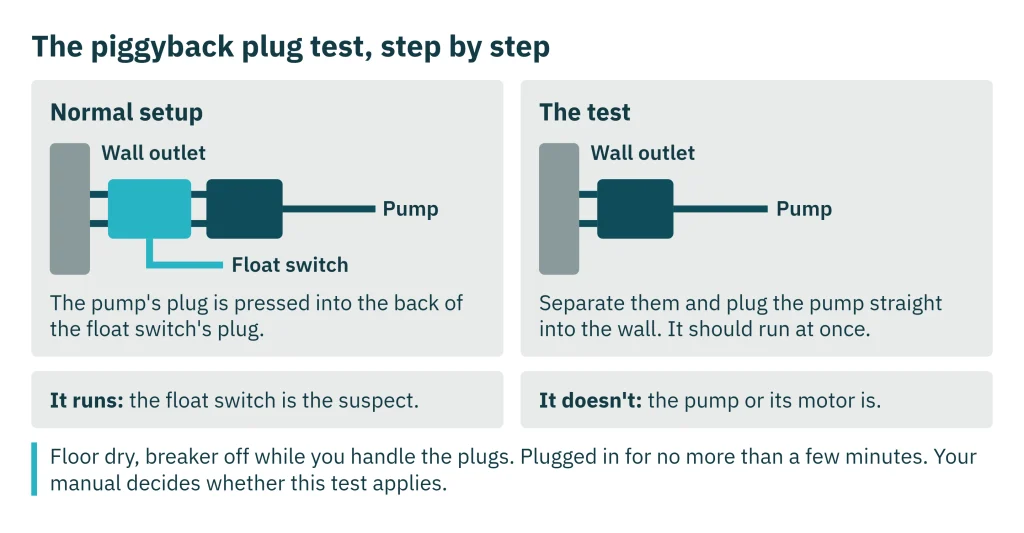
- Test the pump without its switch, if your model allows it. Some pumps have a piggyback plug, with the pump’s plug pressed into the back of the float switch’s plug. Pentair’s test: separate them and plug the pump straight into the wall, with the floor dry and the breaker off while you handle the plugs. It should run at once. If it does, the float switch is the suspect. If it doesn’t, the pump or its motor is. Pentair says not to leave it plugged in for more than a few minutes, because it can overheat. Your manual decides whether this test applies to your model. A pump whose switch plugs into its body can’t be tested this way.
If it stops when hot
A pump that ran, went quiet and later came back may not be broken. It may have overheated. The M53’s sheet lists auto-reset thermal overload protection, and a Wayne utility pump manual (third-party copy) describes the same idea: the protector stops a hot motor before it’s damaged. Wayne adds that if it keeps cutting out, you should disconnect the power and find the cause, and warns that this kind of protector can restart the motor unexpectedly. So a quiet pump isn’t a dead one: cut the power before your hands go near it. Zoeller’s checklist gives incorrect voltage and a mechanically bound impeller among the causes.
Pentair blames heat on low voltage from extension cords or shared circuits, and says the most common cause of failure is “probably” electrical. That’s its own view, not a measured share. The fix it gives is to plug directly into an outlet on its own circuit, and Ann Arbor passes on the same advice from manufacturers. On extension cords the sources differ: Zoeller and Ann Arbor say not to use one, while Pentair says that if one must be used, it should be a heavy enough gauge for the pump and the cord’s length. Follow your manual. If the outlet you need isn’t there, adding one is an electrician’s job.
It hums but moves no water
The motor has power, so the problem is along the water’s path. Don’t leave it humming while you investigate. Cut the power, allow the cooling time above before you lift the pump out, then go through the path from the bottom up.
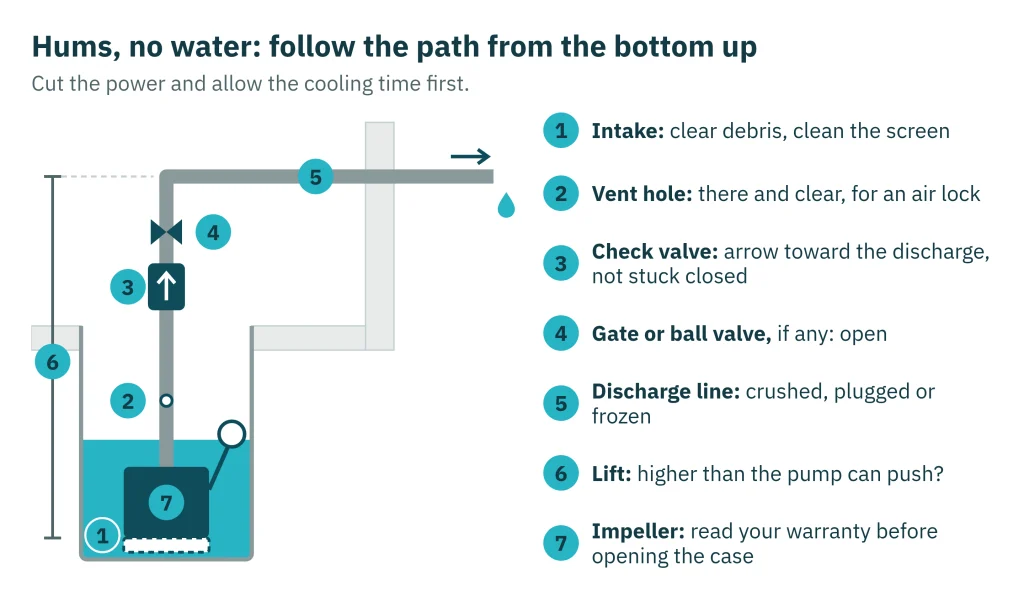
- Intake. Pentair’s first suspect is debris blocking the suction. Pull out what you can reach and clean the screen.
- Air lock. Zoeller’s FAQ says a pump that hums and moves nothing is probably air-locked, and points to a vent hole in the discharge pipe between the pump and the check valve. Check that it’s there and clear. Pentair describes the same fix. Hole sizes differ by maker and model, and some pumps have a vent in the housing, so your manual gives the size and position. Read it before you drill. Zoeller says a water stream shows at the vent on its 50 Series pumps while they run, so don’t plug the hole.
- Check valve. Find the arrow on the valve body. Pentair says it should point toward the discharge. Liberty lists a valve stuck closed or fitted backwards as a cause.
- Shut valves. If your line has a gate or ball valve, Liberty’s chart says to make sure it’s open.
- Discharge line. A crushed hose, a plugged outlet or ice all do the same thing. Liberty’s chart names ice where a line runs into cold areas. See frozen lines below.
- Lift. Every pump has a height it can’t push past. The M53’s maximum head is 19.25 feet. If the pipe was rerouted higher, this may be the cause.
- Impeller. Here the sources disagree. Ann Arbor tells owners to unplug the pump, check the suction screen and replace an impeller with worn or missing blades, and Pentair also says to replace a damaged one. Zoeller says if its checklist doesn’t find the problem, consult the factory and don’t take the pump apart. Liberty’s CSP manual says taking it apart yourself voids the warranty, because only Liberty or its authorized service centers may do so. Read your warranty before opening the case.
It runs, but the pit won’t go down
Go outside and look at the end of the discharge pipe. If water is flowing out and the pit level still isn’t falling, Pentair says more water is coming in than the pump can move. It adds that this isn’t a real problem as long as the pit isn’t overflowing, and that you may want a spare pump on hand. Ann Arbor warns that a pump that can’t keep up may run continuously and burn out.
Measure the flow
If little water is reaching the outlet, measure before you buy anything. You need two numbers from your own pit, taken in dry weather so that inflow doesn’t skew the result:
- Gallons per inch of your basin: 3.14 × radius × radius ÷ 231, with the radius in inches. An 18-inch basin holds 1.10 gallons per inch of depth, a 24-inch basin 1.96. That assumes straight sides and ignores the space the pump takes up, so treat it as an estimate.
- Time one drawdown: measure how many inches the water falls while the pump runs, and how many seconds that takes.
Worked example, our arithmetic: an 18-inch basin drops 4-1/4 inches in 30 seconds. That’s 1.10 × 4.25 = 4.7 gallons in half a minute, or about 9.4 gallons a minute. A copy of a Zoeller data sheet rates the M53 at 34 gallons a minute at 10 feet of total head, which would move those 4.7 gallons in about 8 seconds.
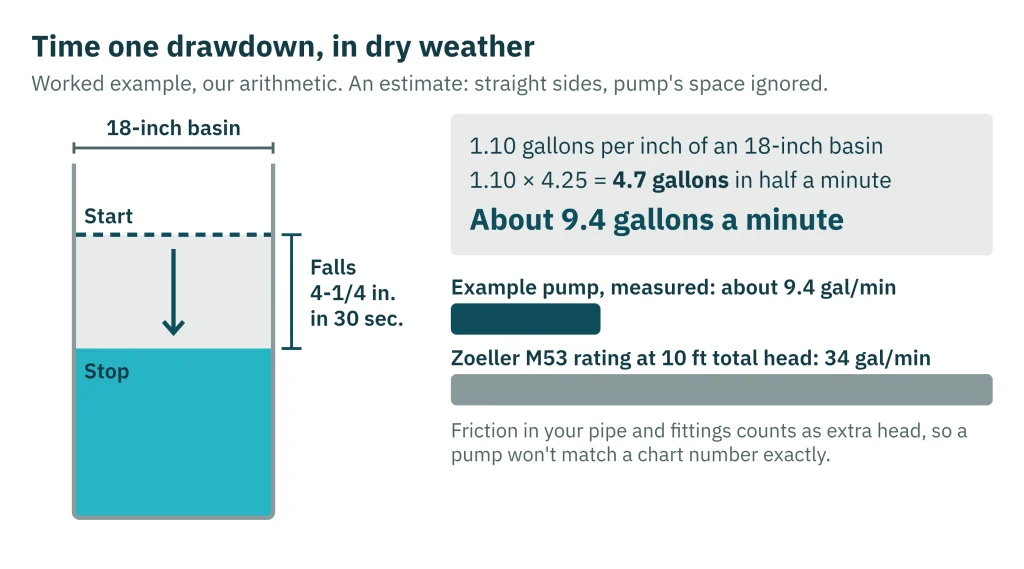
Your pump won’t match a chart number exactly. Friction in the pipe and fittings counts as extra head, and no source we read can say how much for your line. A gap as wide as that one is still a reason to look along it. Zoeller’s checklist blames a drop in capacity after a period of use on a clogged line or check valve, added pipe friction, or abrasive wear on the impeller and housing. Low voltage is on its list too.
If the pump checks out and still can’t keep up, the question is how much water is arriving. The sump sizing calculator turns a timed rise during heavy rain into gallons a minute. The 2024 IRC, P3303.1.1, sets no flow number. It says only that capacity and head should suit the expected use.
Don’t jump to a bigger pump yet. University of Minnesota Extension puts indoor moisture sources, then grading and gutters, ahead of drainage work, and Building Science Corporation says roof runoff must never feed a foundation drain. It also warns that sump water released near the foundation can recycle through the drain. Its answer is a storm sewer or a dry well away from the foundation. We found no national distance, and rules on where the water may go are local, so ask your city. Our guide to basement leaks and where they start sets out the full order of work.
It starts and stops too often
Zoeller’s checklist lists a float tether that’s too short, a check valve stuck open or missing on a long line, an overload cutting out, and a pit that’s too small. Pentair says a tethered float needs at least 3 inches of cord between the ball and the bracket.
No source ranks these causes, so this order is ours: start with the check valve. Ann Arbor explains that if it fails, pumped water flows back into the pit, so each cycle removes less and the pump cycles more, which can shorten its life. Liberty’s 290 Series chart also lists leaking fixtures when a pump runs at intervals with nothing in use, so check those too.
The sources differ on whether the valve is required. The same IRC chapter, at P3303.1.4, says discharge piping shall include an accessible full-flow check valve. Zoeller’s FAQ calls one usually recommended but not required on non-sewage pumps. The IRC is a model code, so check your local adoption. We found no published limit for how many cycles is too many, so we don’t give one.
It trips the breaker or GFCI
Pentair lists water in the cord or float connector as a likely cause, more so on GFCI breakers. It also names a jammed impeller, an extension cord or undersized wiring, a bad float switch and a shorted motor winding. Here are its checks in the order we’d run them, for pumps with a piggyback plug and only on a dry floor with the power off while you handle the plugs:
- Separate the plugs and dry them.
- Plug the pump directly into the outlet, not through an extension cord.
- If it trips only when the float switch is in the circuit, Pentair says to replace the switch.
- If it still trips with the pump alone, and the impeller turns freely when you check it with the power off, a shorted winding is left on Pentair’s list. Its answer for that is a new pump.
A GFCI that trips is reporting a fault or leakage it detected. Don’t remove or bypass it. Have an electrician check the pump, cord and circuit. The 2024 IRC, E3902.5, calls for GFCI protection on basement receptacles, so check your local adoption. You may read older advice against a GFCI on a sump circuit, but it conflicts with this code section. Because a tripped GFCI also stops the pump, the protection is a high-water alarm or a battery backup, not a bypass. We didn’t check whether older homes must add GFCI protection, so we make no claim either way.
Frozen or blocked discharge lines
A pump that runs through the winter can freeze its own line. If it hums or runs and nothing comes out, walk the line and look at its outlet. Plymouth, Minnesota’s winter advice (undated, read 4 November 2026) is the most detailed we found from a public source:
- Remove flexible discharge hoses, which it says aren’t suited to winter and may freeze.
- Clear snow and ice from the outlet.
- Use a rigid pipe with a positive slope, because flat sections and dips hold water that can freeze and block the line.
- Leave an air gap between the pump’s discharge and the underground pipe in case the pipe freezes.
- Add insulation, or a heat cable for outdoor use that’s recommended for PVC.
Plymouth also says not to use heat tape designed to wrap around pipes, because it isn’t weatherproof. We found no maker or agency instructions for thawing a frozen line, so we don’t give any. Call a plumber if it won’t clear.
Don’t solve a frozen line by sending the water to a floor drain or laundry sink. Plymouth bans that by ordinance and can charge a $100-a-month penalty, and it allows temporary winter discharge to the sanitary sewer only by permit in rare cases. Rules are local, so don’t do it, and check with your city.
Repair, replace or call someone
Switch only. Pentair says the float switch is typically the first thing to fail, and that if the pump passes the plug test you can replace the switch and keep the pump. Ann Arbor calls a stuck switch the most common mechanical failure, and says switches are relatively inexpensive to replace. It adds that some homeowners fit a new pump and keep the old one, with a new switch, as an emergency backup.
Whole pump. Pentair says a shorted motor winding means a new pump, and Zoeller says service belongs with its authorized centers. Age alone tells you less than you might read. Zoeller’s FAQ describes a “7-10 year service life” under normal conditions, the only maker figure we found. Pentair gives no figure, but says heat from low voltage can shorten a pump’s life dramatically. Zoeller’s range isn’t a date to replace a working pump.
Who to call. Ann Arbor says most plumbers and some handymen can repair or replace sump pumps. Outlets, circuits and anything that keeps tripping go to a licensed electrician.
Permits. The 2024 IRC, R105, a model code, requires a permit to alter or replace a regulated plumbing system. Whether a like-for-like pump swap counts is decided locally. Hamilton County, Ohio’s public health plumbing page (dated December 2023) says contractors must obtain a permit for sump pump installation but doesn’t address a swap, and the other places we sampled didn’t give a clear, shared answer. New pits, discharge changes and new circuits were permitted more often in those examples, but that’s a pattern, not a rule. Ask your building department before the work starts.
Once it runs again
Run the test Ann Arbor suggests. Pour about 5 gallons of water into the pit, watch the pump start and stop, and check the indoor pipe joints for leaks while it pumps. The city says to do this at least twice a year. Then go outside and check that water is reaching the outlet.
While you’re there, go through FEMA’s home checklist: does the pump have a battery backup, is there an alarm for when water rises above the top of the sump, and is the pump maintained every year? FEMA’s guide also says sump pumps aren’t designed for large amounts of water and won’t work with the power off, so you’d need battery storage or a generator for an outage. CPSC’s 2023 flood warning says generators stay outside, at least 20 feet from the house, and never in a basement.
Our sump pump maintenance guide covers what makers and manuals say about routine care, so the next failure is more likely to show up during a test than during a storm.
This is general information, not engineering, legal, insurance or medical advice. Your pump’s manual, your electrician and plumber, and your local building department decide what applies to your home. Liberty’s manuals were read in third-party copies, because the links on Liberty’s own site failed. The Wayne manual and the M53 data sheet were also read in third-party copies.
Sources checked on 4 November 2026.
Sources
- CDC: Reentering Your Flooded Home (updated 24 August 2026)
- Iowa HHS: Frequently Asked Questions About Cleaning Flooded Basements (revised 23 June 2024)
- Zoeller FM3167: Aquanot Spin system installation instructions and service checklist (March 2026)
- Liberty Pumps 290 Series manual, troubleshooting chart (third-party copy)
- Zoeller M53 specification sheet FM2958 (distributor host)
- FEMA: Urban Flooding: Guidance for Homeowners and Renters (November 2024, revised May 2025)
- City of Ann Arbor: Sump Pump, 7 Causes of Failure (undated)
- Liberty Pumps CSP Series manual, troubleshooting chart (third-party copy)
- Pentair: Sump Pump Troubleshooting FAQ
- Wayne WEU250 utility pump manual (third-party copy)
- Zoeller: Product support FAQ
- Zoeller M53 data sheet with head-flow figures (third-party copy)
- 2024 International Residential Code, chapter 33: P3302 and P3303
- University of Minnesota Extension: Moisture in basements, causes and solutions
- Building Science Corporation: BA-1015 Bulk Water Control
- 2024 International Residential Code, chapter 39: E3902.5
- City of Plymouth, Minnesota: Sump Pumps (undated, read 4 November 2026)
- 2024 International Residential Code, chapter 1: R105
- Hamilton County Public Health, Ohio: Sump Pump Installation (December 2023)
- CPSC: Flood safety news release (11 July 2023)