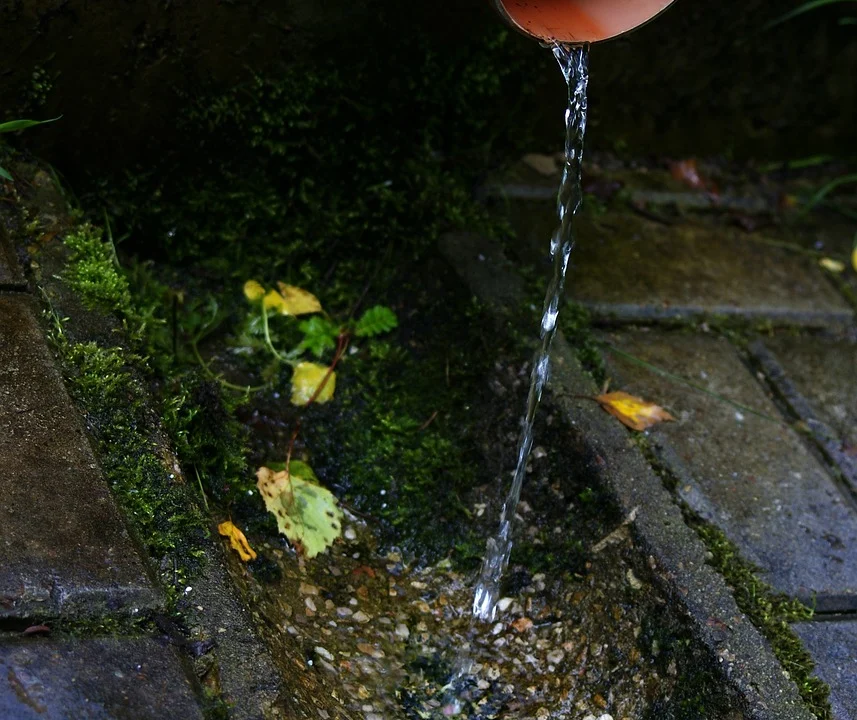
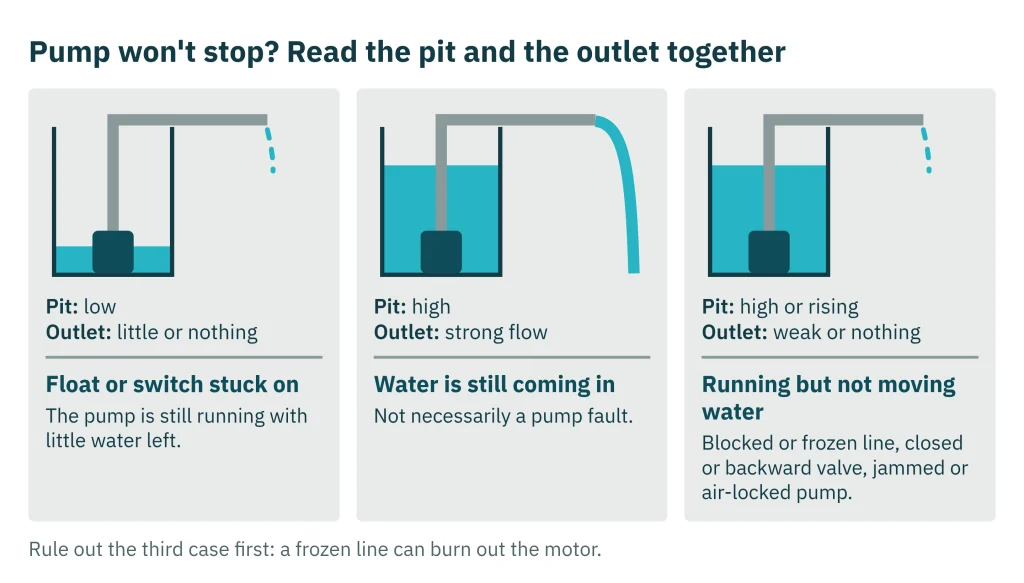
A sump pump that keeps running means one of three things: water is still coming into the pit, the float or switch is stuck on, or the pump is running without moving water. Two looks usually tell you which: the water level in the pit, and the end of the discharge pipe outside.
The first case isn’t necessarily a pump fault. The second can be a quick fix. Check for the third first, because a frozen line can burn out the motor. This page is part of our guide to sump pumps and works through each result using maker manuals and city fact sheets. One thing it won’t give you is a “normal” run time: Zoeller says there’s no set optimum.
Before you touch anything
- Water on the basement floor? Don’t walk in with the power on. Iowa’s health department says to turn off the electricity first, preferably at the meter, and to call the utility if you can’t do that safely. Then go to our flooded basement steps instead of this page.
- Dry floor? You can look into the pit and at the outlet without touching anything. The first check below needs only a flashlight.
- Before your hands go in the pit, follow your manual. Zoeller’s service checklist (March 2026) says to shut off the main power breaker and then unplug the pump, wearing insulated-sole shoes and not standing in water. Under flooded conditions it says to have the electric company or a licensed electrician disconnect power. It also warns that the oil in submersible pumps gets hot and pressurized, and allows 2-1/2 hours after disconnecting before service.
- Sealed lid? Clear-water pits can have sealed lids too, but a sealed lid with a pipe rising from it may belong to something else. EPA notes that a sump can be capped and used as a radon suction point, and the model code requires a gastight cover on sewage pits. Don’t open it until you know what it is, and ask a plumber if you can’t tell. Zoeller says dewatering sump pumps aren’t designed for raw sewage, so this page doesn’t apply to those pits.
- Don’t leave it unplugged. If water is coming in, the pit fills. Plug the pump back in as soon as you finish.
Three quick checks
- Time it. Stay nearby for several minutes. Does the pump ever stop? If it stops and restarts, it’s cycling, not running nonstop. Skip to that section.
- Look in the pit. Is the water low, at or below where the pump normally shuts off? Or high, and is it rising, holding or falling?
- Go outside and find the outlet. Is water coming out strongly, weakly or not at all? If the line is buried or runs to a storm sewer and you can’t see the end, go by the pit level alone: a pump that’s moving water should pull the level down unless inflow matches it.
| Pit level | At the outlet | Most likely | Go to |
|---|---|---|---|
| Low, pump still running | Little or nothing | Float or switch stuck on | Stuck float |
| High, holding or falling slowly | Strong flow | Water is coming in about as fast as the pump can move it | Water still coming in |
| High and rising | Strong flow | More water than the pump can move | Water still coming in; watch for flooding |
| High or rising | Weak flow or nothing | Blocked or frozen line, closed or backward valve, jammed or air-locked pump | Running but not moving water |
| Falls, pump stops, restarts soon after | Comes and goes | Cycling, not nonstop | It stops, then starts again |
| Keeps refilling in a dry spell | Any | An unexpected water source | Running in dry weather |
“High” and “low” depend on your pump. As one example, Zoeller’s M53 sheet gives on and off levels of 7-1/4 in and 3 in. Your manual gives yours. These rows point to a likely cause, and they don’t prove one. Pentair’s troubleshooting FAQ starts from the same split: a pump that runs continuously has either heavy inflow or a stuck float.
Water is still coming in
If water is leaving the pipe but the pit isn’t dropping, Pentair’s reading is simple: more water is entering than the pump can move out. If the pit isn’t overflowing, Pentair sees no real issue, though it suggests keeping a spare pump in case this one fails from overuse. That can be the system doing its job. University of Minnesota Extension notes that the water table can rise with flooding or seasonal conditions. Building Science Corporation says a basement floor below typical groundwater levels will need "significant running of the sump pump system". So a pump running through a long wet spell or a snowmelt isn’t, on that evidence alone, a broken pump.
You’ll see rules of thumb online, such as a pump being undersized if it runs more than half the time in wet weather. No maker or city document we read gives a percent limit, so we don’t use one. What matters is the trend: is the pump holding the level or losing ground?
Before you think about a bigger pump, rule out water you may be pumping twice or sending to the wall yourself:
- Recycled water. Walk the discharge to where it ends. Building Science Corporation says outflow left next to the foundation just recycles through the drain system. It wants a storm sewer or dry well away from the foundation, where your city allows that. No national distance exists. Moorhead, Minnesota, for one, lists a proper storm sewer connection, the ground at least 20 ft from the home, or a buried line to the curb (April 2026). Ask your city.
- Roof water. Building Science Corporation says roof runoff must not be sent into the ground near the building, and especially not into the foundation drain. Check whether downspouts are buried or end near the wall.
- Grading and gutters. UMN’s order of work puts gutters, downspouts and grading ahead of any drainage system, and Building Science Corporation says to look above grade first. Our guide to finding a basement leak’s source walks through that order.
If the pump still can’t keep up, it may be undersized. Ann Arbor’s sump pump sheet says that when water enters faster than a too-small pump can remove it, the system can run continuously and burn out. The model code sets no flow number: P3303 says only that capacity and head must suit the expected use, so check your local adoption. A larger pump moves water faster, but it doesn’t reduce the water. Time your inflow first (next section), then try the pump sizing calculator.
Keep an eye on the limits, too. FEMA’s Urban Flooding guide says sump pumps aren’t designed for large volumes of water and don’t work without power. If the level is rising toward the rim, read the flood steps linked above before you need them.
Put numbers on it
A tape measure and a watch show how hard the pump is working. Read the level down from the rim, with the tape and your hands out of the water. A round basin holds a fixed amount per inch of rise: pi x radius squared / 231. An 18-in basin holds 1.10 gal per inch, and a 24-in basin 1.96 gal. The timed rise comes from a University of Illinois Extension author, writing in a trade magazine in 2013, who times the rise for 60 seconds during heavy rain.
- Inflow. Measure how fast the level rises while the pump is off. If it cycles, do this between runs. If it runs nonstop, this means switching it off as your manual says, so only do it on a dry floor, for 60 seconds, and stop early if the water nears the rim. If the pit is already near empty, skip this: it’s the stuck-float case.
- Net fall. Measure how fast the level falls with the pump running.
- Pump output. Add the two: the pump removes what’s coming in plus what the level drops. If the level rises with the pump on, subtract the rise from inflow instead.
Worked example, 18-in basin. The level rises 4 in in 60 seconds, so inflow is 4 x 1.10 = 4.4 gal a minute. With the pump on, it falls 8 in a minute, which is 8.8 gal a minute. Pump output is about 4.4 + 8.8 = 13.2 gal a minute.
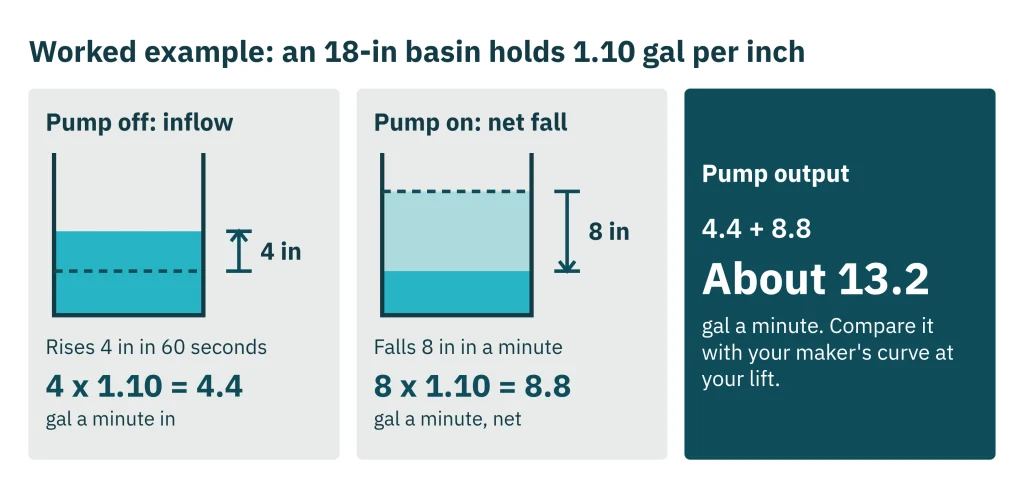
Now compare that with your maker’s curve at your lift. Read off the graph on Zoeller’s M53 sheet, that pump moves about 34 gal a minute at 10 ft and about 19 at 15 ft. A result well under the curve is a reason to check the line and the pump, though a timed reading in a pit is rough and a curve describes a new pump. If inflow is near your output, you’ve found why it won’t stop. Those figures are also what the cycle calculator takes.
The float or switch is stuck on
Ann Arbor calls a switch stuck on or off the most common mechanical failure: the pump runs continuously or not at all. The giveaway is a pump still running with the pit nearly empty. Zoeller’s chart lists three causes for “pump will not shut off”: debris under the float, the float bound by the basin sides or something else, or a switch that’s damaged or out of adjustment.
- Shut off power as your manual says.
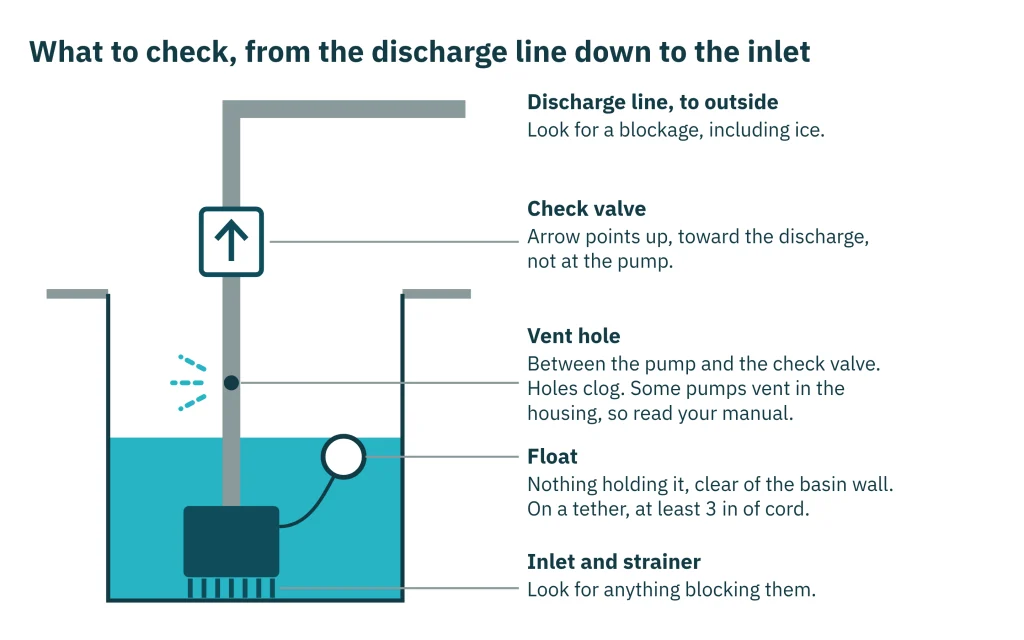
- Look for what’s holding the float. Ann Arbor names a pump that has shifted and pressed the float against the basin wall, and objects such as sand or pea stone. Pentair says to look for anything that keeps the ball from dropping to its off position.
- Clear it. If the pump has moved, Ann Arbor says to reposition it so the float can’t catch.
- On a tethered float, Pentair asks for at least 3 in of cord between the ball and the mounting bracket.
- Restore power and test. To avoid a shock, Pentair says to lift the float with a broom handle or other non-conducting item. The pump should start at its on level, which your manual gives, and stop when the float comes back down. Keep the test short, because the pit may be nearly dry.
If the float moves freely and the pump still won’t stop, the switch is the suspect. Pentair says the float switch is typically the first part to fail, and that you can replace it and keep the pump. Ann Arbor says switches are relatively inexpensive, but how yours is replaced depends on the pump, and Zoeller sends repairs to authorized service centers, so check your maker’s rule first. New wiring or a new circuit goes to a licensed electrician.
Running but not moving water
This is the case to deal with first, because the motor is working against something. Zoeller’s chart says to check the inlet, strainer, discharge pipe and vent holes for obstructions, and also lists lift beyond the pump’s capacity, low voltage and air in the pumping chamber. Liberty’s 290-Series manual (we read a third-party copy) adds these for a pump that runs or hums but doesn’t pump:
- A discharge line that’s blocked, including by ice in cold areas.
- A check valve stuck closed or installed backward. Pentair says its arrow should point up toward the discharge, not at the pump.
- A gate or ball valve left closed.
- An impeller that’s jammed or a pump casing that’s plugged.
Air lock. Zoeller’s support FAQ says a pump that hums but moves no water is probably air-locked, and that a vent hole in the discharge pipe between the pump and the check valve prevents this. Sizes differ: Pentair says 1/16 to 1/8 in, Zoeller’s FAQ says 3/16 in, and its Aquanot manual describes a 1/8 in air relief hole that normally sprays while the pump runs. Zoeller’s 50 Series has a vent in the pump housing, so read your manual before drilling. Holes clog, and Zoeller says to check them periodically.
Low power. Zoeller says not to use an extension cord, because a long or light one may not deliver enough voltage. Ann Arbor says makers recommend plugging straight into an outlet that’s the only load on its circuit.
Frozen lines
In cold weather, check the outlet first. Winnipeg, Canada (updated April 2024), warns that a frozen hose can overheat and burn out the pump, and it tells residents to disconnect flexible outdoor hoses once it’s below freezing. Fargo’s undated FAQ says not to keep a long hose connected in winter, that 8 to 10 ft will clear itself after each discharge, and that it should lie on ground sloping away from the house. Moorhead reminds residents to check lines for ice and blockages. These are three northern cities, not a national rule.
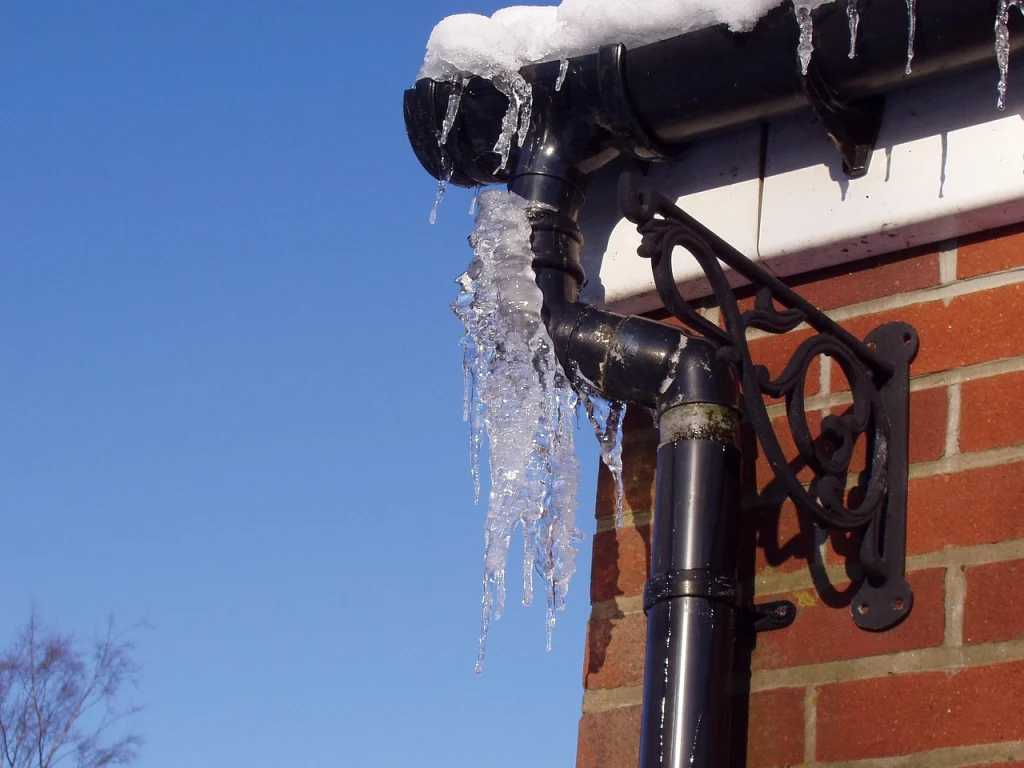
Liberty says to clear ice from the line, but we found no maker or city instructions on how to thaw one, so we don’t give any: call a plumber. Disconnecting a frozen hose lets the pump discharge again, but the water lands closer to the wall, so treat it as a stopgap (that’s our reasoning).
Don’t solve a frozen line by running the water into a floor drain or laundry tub. The default is don’t, and check with your city. Some cities ban sump water in the sanitary sewer: Manville, New Jersey is one. Fargo describes a seasonal winter program, but that’s for a city to approve, not for you to assume.
It stops, then starts again
Plenty of pages list a bad check valve as a cause of constant running. The maker charts we read put it somewhere else. Zoeller’s chart files “check valve stuck open, or none installed in long distance line” under starts and stops too often, along with a float tether that’s too short, an open overload and a pit that’s too small. Ann Arbor describes the mechanism: pumped water falls back into the pit, so each cycle removes less and cycles come more often, which can wear the pump out early. Liberty lists a missing, stuck or leaking check valve for a pump that runs periodically.
A quick sign is water rushing back down the pipe just after the pump stops, followed by a jump in the pit level. That’s our reasoning from how the valve works. Zoeller’s FAQ calls frequent starts short cycling and ties it to basin diameter and the on/off range. It says a check valve is recommended, not required, on non-sewage submersibles, but the model code’s P3303 does call for an accessible full-flow check valve, so code comes first where it’s adopted. For a number, a Zoeller technical brief (undated) recommends designing systems with motors of 1.5 hp or less for no more than 12 starts an hour, and says going over at times isn’t a problem. That’s a design target, not a fault test. “Overload open” is different. We read it as the motor’s protection cutting out: the M53 sheet lists an auto-reset thermal overload, so the pump would stop with water still high and may restart. See our troubleshooting guide for a pump that won’t run.
Running in dry weather
If it hasn’t rained, start by finding where the water enters the pit.
- From the drain pipes or the basin sides. That points to groundwater (our reasoning), which doesn’t need rain that week: UMN says the water table can rise with seasonal conditions, and we found no figure for how long it stays up.
- From a pipe that isn’t part of the foundation drain. A softener, laundry or condensate line sending water to the pit will trigger the pump each time it discharges. Whether it may drain there is a local plumbing question.
- From a leak. Liberty lists leaking fixtures for a pump that runs periodically with no fixtures in use, which fits a basin that fixtures drain into (our reading). A foundation-drain pit is different: a leak would have to reach it through the soil. If you have a water meter, use EPA’s test: read the meter before and after two hours with no water in use. If it changes at all, you probably have a leak. A leak can be anywhere past the meter, including an outdoor irrigation line, so it doesn’t prove the water is reaching your pit, and it won’t catch a leak on the street side (that’s our reasoning). If you suspect water from a city line, call your water utility.
What it risks and costs
- Burnout. Ann Arbor says continuous running from an undersized pump can burn it out. Winnipeg says the same of a frozen hose.
- Wear. Zoeller’s brief separates heat from wear. It says nearly all its pumps are rated to run indefinitely without overheating, given a proper minimum water level, operation on the published curve and allowable temperatures. But it says its sump pumps generally aren’t recommended for nonstop running, because parts such as bearings and seals wear much faster.
- Running dry. In its backup-pump test steps, Zoeller cautions that continuous dry running may overheat the pump and damage its seals. That’s the stuck-float case, so don’t leave it.
- Electricity. A running pump draws no more than its amps times volts. The M53 sheet lists up to 9.7 A at 115 V, or 1,116 W at most. Running 24 hours, that’s about 27 kWh, or about $4.86 a day at the US residential average of 18.16 cents per kWh (EIA, August 2026). A Liberty 257 at 5.2 A would be 598 W, or about $2.61 a day. Both are upper limits: the power factor isn’t published, and actual draw can be lower.
- Age. Zoeller’s FAQ says its units are designed for 7 to 10 years under normal service, and that switches average 4 to 7 years, depending on the application. Those are the only maker figures we found, and they’re no reason alone to replace a pump.
A pump that’s working hard can fail. Zoeller, which sells them, recommends a high-water alarm on any submersible system, and FEMA’s home checklist asks whether you have an alarm and a battery backup.
When to call someone
- A plumber: the pump still won’t stop after you’ve cleared the float; the line is frozen or blocked; or the pump runs but moves nothing. Ann Arbor says most plumbers can repair or replace pumps.
- A licensed electrician: a breaker or GFCI keeps tripping. A GFCI that trips is reporting a fault or leakage it detected. Don’t remove or bypass it. Because a tripped GFCI stops the pump, a high-water alarm or battery backup is the protection. Pentair lists wet plug connections, a jammed impeller, an extension cord, a bad float and a shorted winding among the causes.
- Your electric company or an electrician: the basement has flooded and you can’t reach power from a dry place.
- Your water utility or a plumber: the meter moves with everything off.
- Your building department: before you change a discharge line or add a pit. Whether a like-for-like pump swap needs a permit is local, so ask.
Lowest Floor sells no pumps and refers no installers. This page is general information, not engineering, legal, insurance or medical advice. Your maker’s manual, your city and the licensed trades decide what applies to your house.
Sources checked on 4 November 2026.
Sources
- Iowa HHS: FAQ About Cleaning Flooded Basements (rev. 23 June 2024)
- Zoeller FM3167, Aquanot Spin system with primary pump, installation instructions and service checklist (03/2026)
- EPA: Consumer's Guide to Radon Reduction (2016)
- 2024 International Residential Code, chapter 30, P3007
- Zoeller M53 specification sheet FM2958 with performance curve, distributor host
- Pentair sump pump troubleshooting FAQ
- University of Minnesota Extension: Moisture in basements, causes and solutions
- Building Science Corporation, BA-1015: Bulk Water Control
- City of Moorhead: Spring reminder, time to redirect your sump pump (8 April 2026)
- City of Ann Arbor: Sump Pump, 7 Causes of Failure (fact sheet, undated)
- 2024 International Residential Code, chapter 33, P3303
- FEMA: Urban Flooding, Guidance for Homeowners and Renters (Nov 2024, rev. May 2025)
- Duane Friend, U. of Illinois Extension, Sizing Up a Sump Pump, WATERPROOF! (15 April 2013)
- Liberty Pumps 290-Series manual, third-party copy
- Zoeller product support FAQ
- City of Winnipeg: Sump pump discharge questions and answers (updated 11 April 2024)
- City of Fargo: Sump pump program FAQs (undated)
- Manville, NJ: Ordinance 2020-1233, sump pump connection inspection (archived copy)
- City of Fargo: Sump pump program history and regulations
- EPA WaterSense: Fix a Leak Week (updated 13 March 2026)
- EIA Electric Power Monthly, Table 5.6.A (August 2026 data)
- Liberty 250-Series specification sheet (2019), distributor host
- Zoeller: What Is the Optimum Sump Pump Run Time? (1 October 2024)
- Zoeller: Continuous Duty vs. Continuous Operation, technical brief (undated)