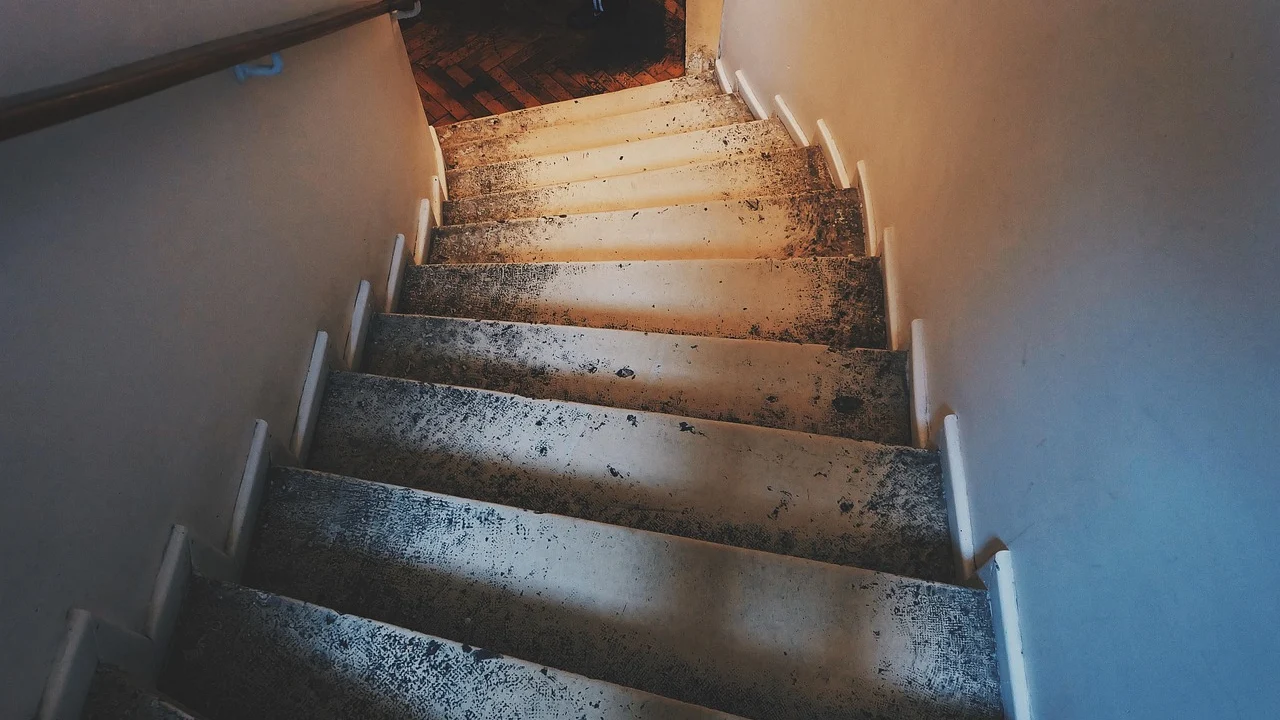
A musty basement smell is a moisture signal. CDC says mold “can smell musty”, and EPA says you may suspect hidden mold when a building smells moldy but you can’t see the source. So find what is damp, stop the water or humid air reaching it, remove anything that grew, and keep the humidity down. Sprays and absorbers skip those steps, and one popular gadget, the ozone generator, can damage your lungs.
This guide is part of our damp, mold and air guides. It starts with a quick check that the smell really is musty, because two other basement smells need a different response. You’ll need a flashlight and a hygrometer, a small gauge that reads relative humidity. Then it moves through where the moisture is hiding and what to fix in what order. If you can see running water, go to our guide on finding the source of a basement leak first.
First, name the smell
We didn’t find an agency smell chart for basements, so treat this table as a starting point. The gas and rodent steps come from the sources named; matching a smell to a cause is our reasoning.
| If it smells like | It could be | Do this first |
|---|---|---|
| Rotten eggs, sulfur or garlic | Natural gas. Wisconsin’s utility regulator says gas odorant is described that way. It could also be sewer gas | Leave. From a safe distance outdoors, call the gas utility’s emergency number or 911. Avoid phones, lights and appliances near a suspected leak |
| A drain or sewer | A dry floor drain trap, or a drain problem | Refill the trap (below). If water is coming up, stop and read the backup section below |
| Urine, or something dead | Rodents or another animal | Follow CDC’s cleanup steps (below). No sweeping or vacuuming |
| Damp cardboard, wet towels, wet earth | Damp material, mold or mildew | Carry on with this guide. Kansas State University calls mildew one type of mold, so “mildew smell” and “musty smell” get the same treatment here |
If you can’t tell gas from sewer gas, treat it as gas. A smell that fades isn’t an all-clear, either. Hydrogen sulfide, often called sewer gas, smells like rotten eggs at very low levels, but ATSDR says people can lose the ability to smell it after about 2 to 15 minutes at about 100 parts per million, so the odor is not a reliable warning.
A dry floor drain
A floor drain’s trap holds water that blocks odors from the drain line, as the note to the traps chapter of the 2024 International Residential Code (IRC) explains. A drain that rarely gets water can slowly lose that water to evaporation. South Davis Sewer District in Utah suggests pouring a cup or two of water into seldom-used drains. It’s the cheapest check on this page, so do it now and see whether the smell changes over the next day.
For new work, IRC P3201.2.1 requires traps subject to evaporation to be protected by a trap primer or a barrier device. The IRC is a model code, so check your local adoption, and ask a plumber if the trap keeps drying out or the smell survives a refill. If a drain is pushing water up instead, treat that water as sewage and read about a basement floor drain backing up.
Signs of rodents
CDC’s rodent cleanup page says to open all doors and windows for 30 minutes first and leave the area during that time, then put on rubber or plastic gloves. Spray a dead rodent, nest and the area around it with disinfectant, or urine and droppings until very wet, and let it soak for 5 minutes or as the label says. Wipe up urine and droppings with paper towels and put them in a covered garbage can. Double-bag a dead rodent or nest. CDC says not to sweep or vacuum urine, droppings or nests, and that a heavy infestation calls for additional precautions.
No smell doesn’t clear the air
Radon has no smell at all. EPA says the only way to know whether a home has a radon problem is to test for it, and it recommends testing all homes. A musty basement and a radon problem are separate questions, so fixing one tells you nothing about the other.
Read the humidity
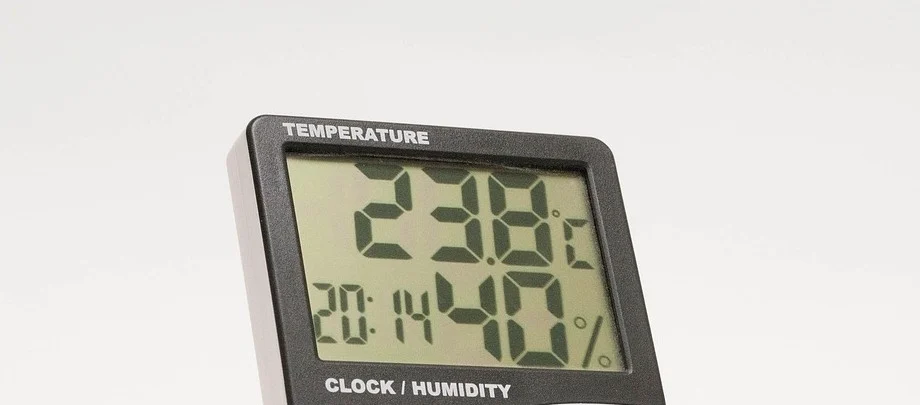
Put the hygrometer in the basement, away from a wall, and read it morning and evening for a few days. Do it with the windows shut and again in the conditions when the smell is worst. The agencies don’t quite agree on the target, so here are their numbers side by side.
| Source | Figure |
|---|---|
| EPA (updated 18 Feb 2026) | Below 60%, ideally 30 to 50% |
| CDC (dated 26 Sep 2024) | No higher than 50% |
| ENERGY STAR (read 4 Nov 2026) | 30 to 50% in general; 30 to 40% in the heating season in colder climates, to prevent window condensation |
| University of Missouri Extension (2018) | 30 to 50% |
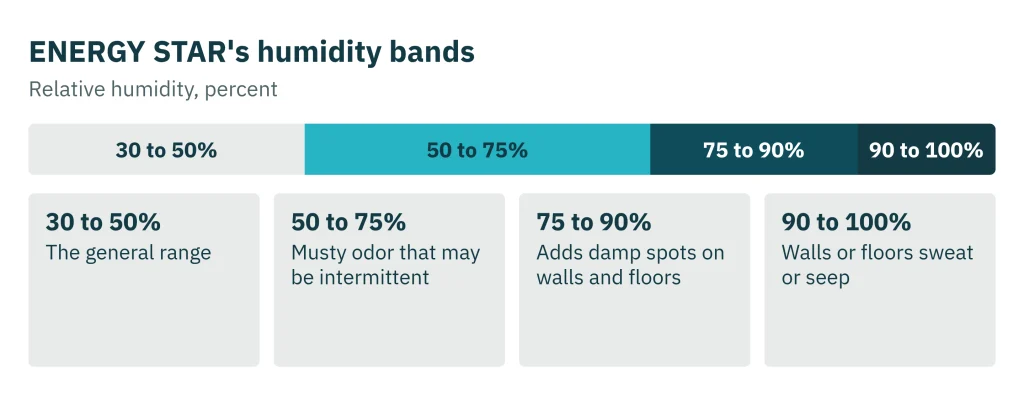
The lowest damp category in ENERGY STAR’s dehumidifier sizing table is useful here: 50 to 75% humidity in a space that “has musty odor that may be intermittent.” Its next band, 75 to 90%, adds damp spots on walls and floors, and at 90 to 100% walls or floors sweat or seep. A high reading tells you the air is carrying moisture. A normal reading doesn’t clear the basement, because the source may be one wet carpet or the back of one wall.
When does it smell?
The pattern narrows things down faster than sniffing corners.
| Pattern | Points toward | Check next |
|---|---|---|
| Summer, especially with windows open | Condensation. University of Minnesota Extension says warm, humid outdoor air condenses on cool basement walls and floors, and many homeowners mistake that for a leak | Close the windows and watch the hygrometer. Look for sweating pipes and damp floors |
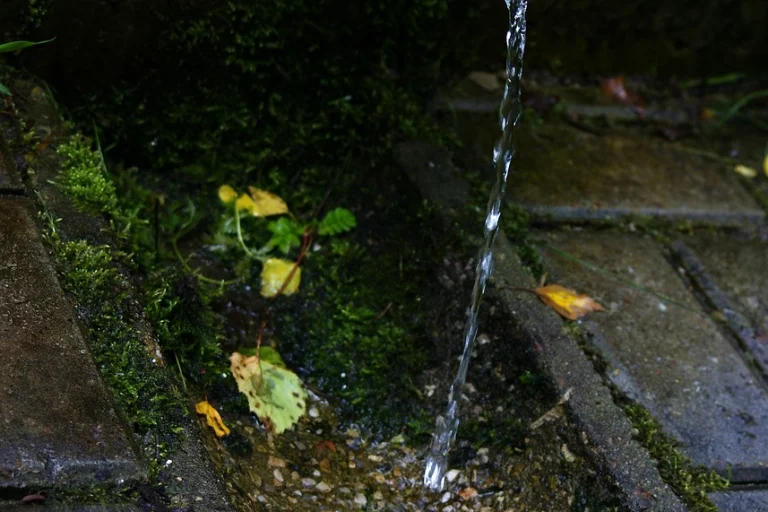
| After rain or snowmelt | Liquid water reaching the foundation | Gutters, downspouts and grading, then the wall and the wall-floor joint |
| All year, in one area | A damp material or hidden growth | The table in the next section |
| All year, everywhere, no visible water | Moisture moving through concrete, moist air drawn in, or old growth in finishes | The plastic test and the “dry but musty” section |
| Upstairs too | Basement air reaching the living space. UMN says most Minnesota basements connect to the rest of the house through ductwork or other openings | Ducts and the sump pit, as well as the basement itself |
| Soon after a flood or leak | Growth in materials that stayed wet. CDC’s flood guide says to assume mold if things weren’t dried within 24 to 48 hours | If water is still standing, don’t go in with the power on; the same guide says to make sure electricity and gas are off first. Then start with the cleanup section |
Where to look
EPA’s list of hidden mold locations includes the back of drywall and paneling, the underside of carpets and pads, walls around leaking or condensing pipes, walls behind furniture, and ductwork. Here is that list in basement order, with the other places our sources name.
| Place | What to look for | Why |
|---|---|---|
| Carpet on the slab | Staining, damp pad, a smell stronger at floor level | Kansas State says basement carpet often has mold on or under it when laid on a cool, damp concrete floor. UMN says slabs must be warm and dry before carpeting |
| Walls behind furniture and shelves | Spots or damp on the wall once items are pulled away | EPA names these as places condensation forms |
| Stored boxes, books, clothes, luggage | Soft or stained cardboard, musty fabric | CDC’s flood guide lists clothing, furniture, cardboard boxes and books as places to see or smell mold |
| Cold water pipes | Drips, rust | EPA treats rust on a drainpipe as a sign of condensation, and says to insulate cold pipes |
| Base of the walls | A ring of dampness, white mineral deposits, stained or blistered wall covering | UMN says capillary suction pulls water through concrete and leaves that ring. Building Science Corporation lists efflorescence among the signs of moisture problems |
| Finished walls and ceilings | Stains, swelling, soft baseboards | Building Science Corporation warns that finishes can hide bulk water for long periods |
| Sump pit | An open pit, standing water | Kansas State lists water in sump holes as a moisture source. UMN says stack effect draws moist air in through open sumps |
| Dryer, humidifier, bathroom | An unvented dryer, a running humidifier, a fan-less shower | UMN names these as interior sources |
| Floor registers in older homes | Ducts under the slab with water in them | UMN warns that standing water in under-slab ducts carries potentially serious health consequences from mold |
| Block walls | Open cores along the top course | UMN says moist air can be drawn through the block cores |
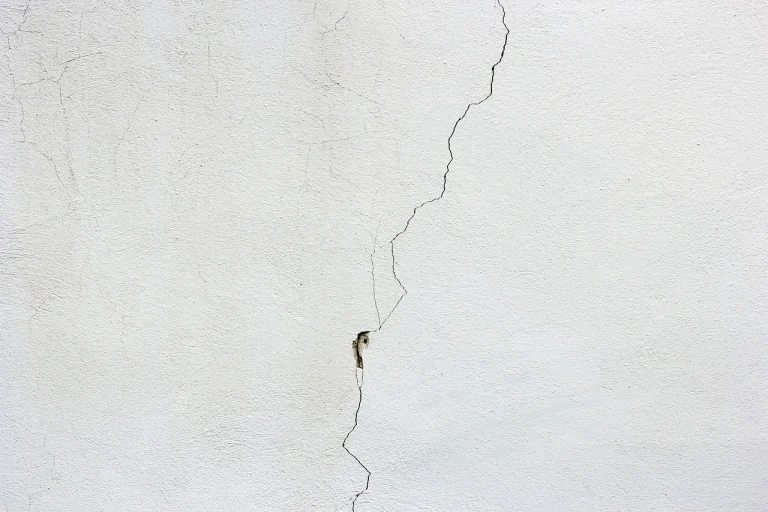
Look before you pull. EPA warns that disturbing a hidden patch can release a burst of spores, and uses wallpaper as its example. If you believe mold is hidden, it says to consider hiring an experienced professional. If you find a horizontal crack or a wall that bows inward, stop treating this as a smell problem and call a structural engineer first.
Try the plastic test
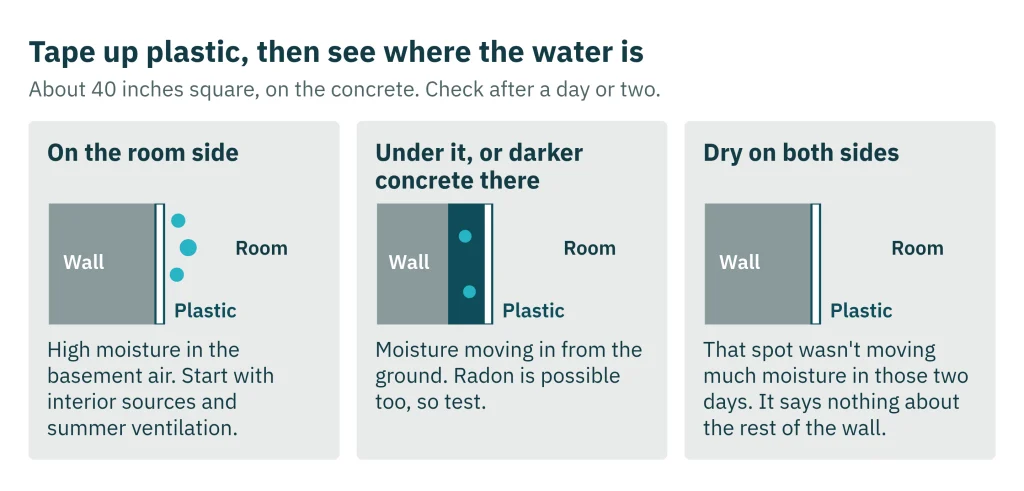
This one comes from Natural Resources Canada. Tape a sheet of plastic about 40 inches square to the concrete wall or floor and check it after a day or two.
- Water on the room side of the plastic points to high moisture in the basement air, so start with interior sources and summer ventilation.
- Water under the plastic, or darker concrete there, points to moisture moving in from the ground. The Canadian guidance adds that this raises the possibility of radon too, which is one more reason to test.
- Dry on both sides says that spot wasn’t moving much moisture in those two days. It says nothing about the rest of the wall, or the next storm. That reading is ours.
Dry, but still musty
“Dry” usually means no puddles. A basement can show none and still have damp materials. Four explanations fit what our sources describe, and more than one can be true at once.
- Vapor through the concrete. NDSU Extension says musty basement odors can come from water vapor entering through concrete walls and floors from wet soil. UMN describes the same movement, from wetter ground to drier indoor air. You won’t see it as water.
- Moist air drawn in. UMN says warm air rising through the house lowers the pressure in the basement and pulls moist air through cracks, open sumps and block cores.
- Growth you can’t see. Behind paneling, under carpet pad, on the back of drywall. This is the case EPA describes: the smell is there, the source isn’t in view.
- Old damage. A leak fixed years ago can leave mold in carpet, drywall or stored items. EPA’s guide notes that dead mold may still cause allergic reactions in some people, and must be removed, not only killed. Whether a material still smells long after it dried isn’t something our sources address. If it smells, assume you have more to find.
Fix the cause, in this order
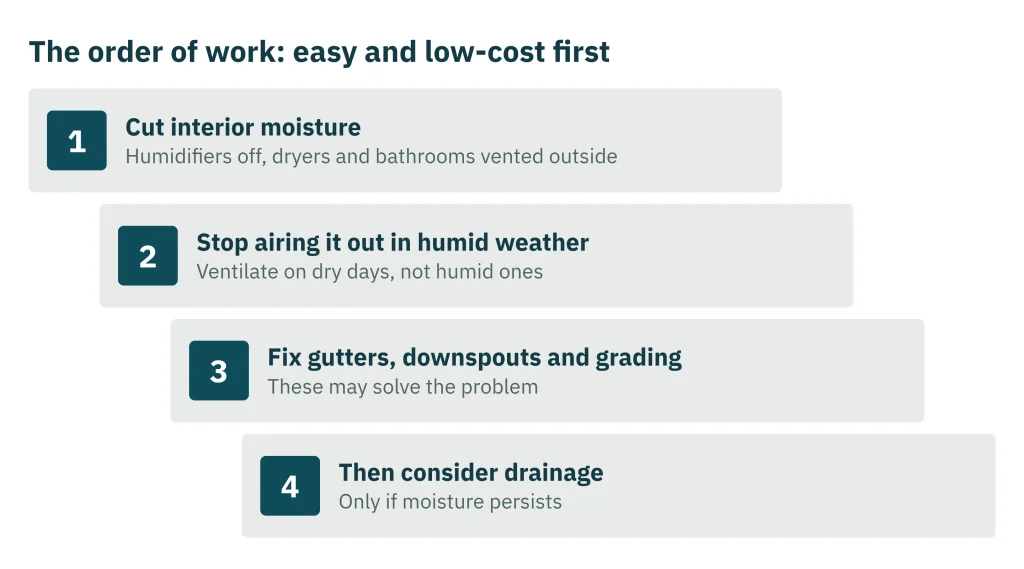
This order comes from UMN Extension, which says to control the source first and to start with what’s easy and low-cost. Building Science Corporation agrees that many foundation water problems start above grade, and that’s the first place to look. A smell by itself doesn’t show that you need a drain, a membrane or a pump.
- Cut interior moisture. Turn off humidifiers in the basement and vent dryers and bathrooms outside. ENERGY STAR also says reducing moisture sources can reduce the need for dehumidifying. Insulate cold water pipes, as EPA advises.
- In humid weather, stop airing the basement out. Some articles say to open the windows. UMN says not to ventilate directly with warm, humid air, and suggests going through an air conditioning system or a desiccant-type heat exchanger instead. EPA’s general advice to increase ventilation “when practical” doesn’t mention humid weather. Kansas State fills the gap: opening windows may help if relative humidity is lower outside than in. So ventilate on dry days, not humid ones. If the hygrometer climbs when the windows open, close them.
- Fix gutters, downspouts and grading. UMN wants at least one downspout per 50 feet of eave and extensions reaching at least 4 feet past the wall. Our downspout flow calculator shows how much water each downspout carries. For grading, UMN says at least 1 inch per foot for 6 feet, and IRC R401.3 says 6 inches within the first 10 feet (check your local adoption). The grading slope calculator compares your slope with each. UMN says these fixes may solve the problem.
- Then consider drainage. If moisture persists, UMN moves on to an interior or exterior drainage system. Our fixes in order explain the options.
Where a dehumidifier fits
A dehumidifier helps, but it treats the air, not the cause. UMN says it can reduce humidity and odor but is not a permanent or complete solution, and warns that in a basement with moisture problems it can pull moisture in faster, causing efflorescence, spalling and further damage to finishes. So fix the source, then use it to hold the humidity in range, or use it for a basement that’s damp only in humid months. ENERGY STAR says frost can form on coils below 65 F, and to consider a low-temperature model. Empty or drain it reliably, because Kansas State says mold can grow in water left standing in the collection pan. Our dehumidifier size calculator estimates capacity and running cost.
The sump lid question
If an open sump pit is a suspect, the sources disagree on the lid, so here is each position. IRC P3302.1 doesn’t require a gastight cover on a clear-water sump. IRC Appendix BE, which applies only where adopted, calls for a sealed or gasketed lid on sumps open to soil. UMN says sumps should have an airtight cover, Building Science Corporation says the same for indoor air quality, and Chicago’s sump pit section, in its sanitary drainage article, requires a gas-tight removable cover. Ask your building department what applies, and keep the pump and float reachable for service.
Clean up what grew
EPA says the moisture problem must be fixed for a cleanup to count as finished, so deal with the source as well. EPA’s size rule: under about 10 square feet, roughly 3 feet by 3 feet, you can usually do it yourself. Above that, or with a lot of water damage, it points to its larger guide, written for schools and commercial buildings. Mold or damage from sewage or contaminated water needs an experienced professional. Our page on mold in the basement goes deeper. The short version:
- Who should stay out. CDC says people with allergies, asthma, COPD, lung disease or weakened immunity should not clean mold. If you have asthma, COPD or a weakened immune system, it says not to be in the home during cleanup.
- What to wear. CDC says at least a NIOSH-approved N95 respirator, goggles without open vent holes, and non-latex, vinyl, nitrile or rubber gloves.
- Hard surfaces. EPA says to scrub mold off with detergent and water, and dry completely.
- Soft things. EPA says porous items such as carpet and ceiling tile may have to go, because mold can be hard or impossible to remove from them completely. CDC gives the same advice for items that can’t be cleaned and dried.
- Fans. CDC’s flood guide says not to use fans once mold has started to grow, because they may spread it.
Bleach: sources differ. EPA says a biocide such as chlorine bleach is not recommended as a routine practice during mold cleanup. CDC says bleach or dish detergent can be used, with no more than 1 cup of bleach per gallon of water. Some home sites print stronger mixes than that. Detergent first fits both agencies. If you do use bleach, EPA says to ventilate the area and exhaust the air outdoors. Never mix bleach with ammonia or, as CDC adds, any other cleanser.
Testing: CDC does not recommend mold testing. EPA says sampling is usually unnecessary if you can see mold, and that no federal limits exist to compare results against. CDC’s guide says that whatever kind of mold it is, the job is the same: clean it up and fix the moisture. EPA says surface sampling may help show whether an area was adequately cleaned, and that sampling belongs with professionals who have specific experience in it.
What doesn’t fix it
| Popular advice | What the sources say |
|---|---|
| Ozone generators | Some home sites recommend them. EPA says that at concentrations within public health standards, ozone is not effective at removing many odor-causing chemicals and doesn’t effectively remove mold. It also says inhaled ozone can damage the lungs. Don’t use one |
| Air fresheners and plug-ins | Missouri Extension warns they mask the odor, which removes a warning sign of mold |
| Baking soda, vinegar, cat litter, charcoal | None of the agency or extension pages we read recommends these for a musty basement. None of them stops moisture. If you try one, do it after the source is fixed |
| Painting or caulking over mold | EPA and CDC both say don’t: clean and dry first. EPA says paint over mold is likely to peel |
| Sealer or coating on the inside of the wall | UMN says interior coatings are temporary. The water is still there, and they deteriorate or move it elsewhere |
| Steam-cleaning the carpet | Missouri Extension says this can worsen a mold problem by adding moisture |
| Duct cleaning as a first step | EPA says clean ducts only as needed, for example with substantial visible mold on hard ducts. Wet or moldy duct insulation should be replaced. The mold returns if the moisture source remains, and sealants should never cover active growth. EPA’s mold guide says not to run the HVAC system if you know or suspect it is contaminated |
You may also see figures such as “60% of US basements have moisture problems” on sales pages. We looked for a study behind that figure in November 2026 and didn’t find one. That doesn’t prove it wrong, but we don’t use it.
How you’ll know it worked
EPA’s finish line is plain: the water or moisture problem must be completely fixed, visible mold and moldy odors should be gone, and a return visit shortly after should show no new water damage or growth. CDC’s version: “If you still see or smell mold, you have more work to do.” Neither gives a number of days, and EPA calls it a judgment call in the end. Keep the hygrometer running through a humid summer and a wet spring, since those are the conditions that started this. If the smell comes back with the rain, the source wasn’t fixed. Hold off on insulating or finishing until then: UMN says walls must be dry first, and that finishing over a moisture problem can make health conditions worse.
Who to call
Lowest Floor sells and installs nothing and refers no one, so this list names the type of help, not a firm.
| If | Call |
|---|---|
| You smell gas | The gas utility’s emergency number or 911, from outside |
| Sewer smell after refilling the trap, or anything backing up | A plumber or your sewer utility |
| Hidden mold is likely, the area is over 10 square feet, or sewage is involved | A mold professional. CDC’s flood guide suggests one affiliated with or certified by NEHA, AIHA, IICRC or ACAC, and says your state may regulate mold work |
| Horizontal cracks or bowing walls | A structural engineer, before any repair firm |
| Health problems that get worse at home | Your doctor. CDC’s flood guide says mold exposure can lead to asthma attacks, eye and skin irritation and allergic reactions, and severe infections in people with weakened immune systems |
This page is general information, not engineering, legal, insurance or medical advice. Local codes, your building department, a licensed professional and your doctor decide what applies to your home.
Kansas State’s bulletin is dated September 1995 and Missouri’s article 2018. CDC’s flood guide (June 2015) is written for post-disaster cleanup. Sources checked on 4 November 2026.
Sources
- CDC: About Mold (dated 26 September 2024)
- CDC: Mold Clean Up Guidelines and Recommendations (16 February 2024)
- CDC: Homeowner's and Renter's Guide to Mold Cleanup After Disasters (June 2015)
- EPA: A Brief Guide to Mold, Moisture and Your Home (updated 18 February 2026)
- EPA: A Brief Guide to Mold, Moisture and Your Home, PDF
- EPA: Mold Remediation in Schools and Commercial Buildings
- EPA: Ozone Generators that are Sold as Air Cleaners (updated 19 February 2026)
- EPA: Should You Have the Air Ducts in Your Home Cleaned? (updated 19 February 2026)
- EPA: Basic Radon Facts
- University of Minnesota Extension: Moisture in basements, causes and solutions
- Building Science Corporation: BA-1015, Bulk Water Control Methods for Foundations
- NDSU Extension: Musty Basements Could Be a Sign of Mold
- University of Missouri Extension: Managing household mold (13 April 2018)
- Kansas State University: MF-2141 Controlling Mold Growth in the Home (September 1995)
- ENERGY STAR: Dehumidifiers
- Natural Resources Canada: Keeping the Heat In, Section 6
- ATSDR: ToxFAQs for Hydrogen Sulfide (October 2024)
- Public Service Commission of Wisconsin: Natural Gas Consumer Safety
- South Davis Sewer District: Understanding sewer odors and P-traps (19 January 2026)
- CDC: How to Clean Up After Rodents (8 April 2024)
- 2024 IRC Chapter 32, Traps
- 2024 IRC Chapter 33, Storm Drainage
- 2024 IRC Chapter 4, Foundations
- 2024 IRC Appendix BE, Radon Control Methods
- Chicago Municipal Code 18-29-712.3.2