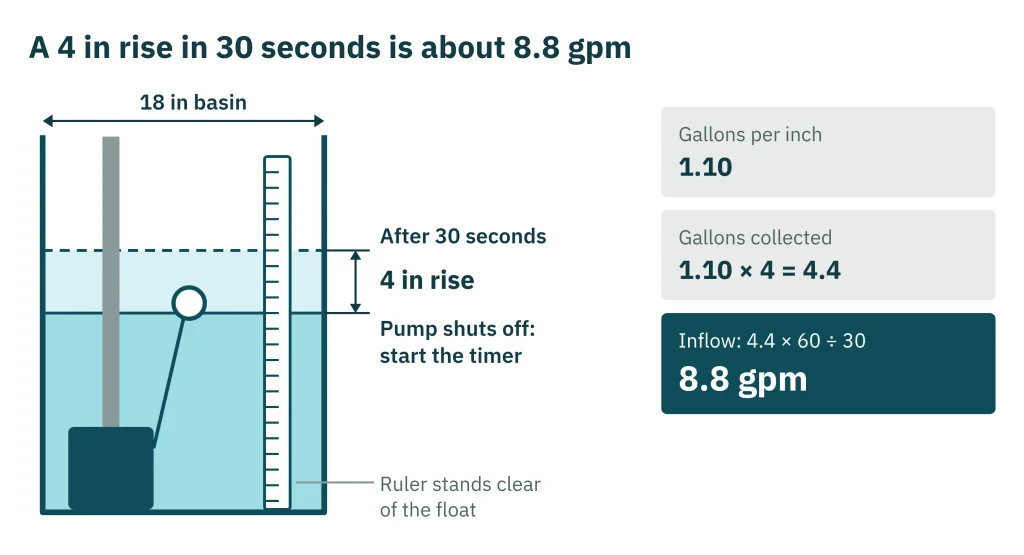
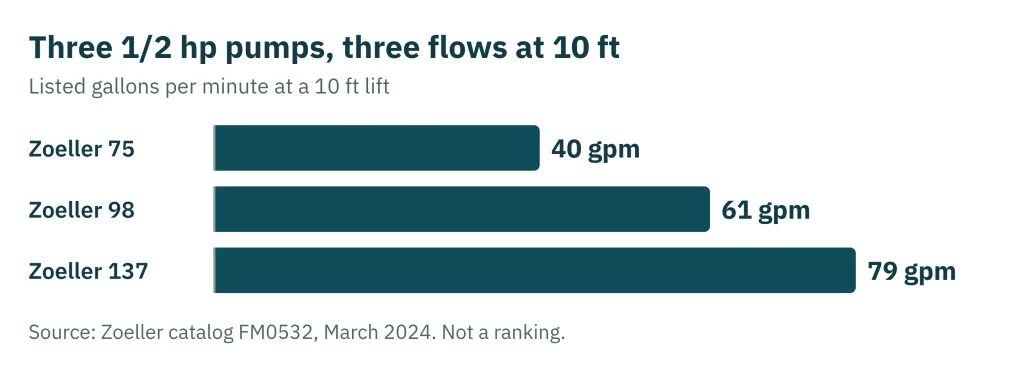
What size sump pump you need comes down to two numbers you can measure: how many gallons a minute reach your basin in heavy rain, and how high the pump has to lift them. In an 18-inch basin each inch of rise is 1.10 gallons, so a rise of 4 inches in 30 seconds is about 8.8 gallons per minute (gpm). Compare that with the flow your pump lists at your lift. Horsepower alone won’t tell you: at 10 ft, one maker’s catalog lists 40 gpm for one 1/2 hp model and 79 gpm for another.
For how pumps work, fail and get backed up, start at our sump pump guides. The calculator on this page does the rise-to-gpm arithmetic and shows its working. The result is an estimate from one test, and the pump’s maker and your building department have the last word. The model code we read gives no flow number. If your number comes out high, check gutters, grading and indoor moisture before you spend money on a bigger pump.
Time the rise in your basin
This is the test published by Duane Friend of University of Illinois Extension, in WATERPROOF! magazine in April 2013. We couldn’t find the original extension paper, so we credit the magazine. Do it in the heaviest rain you can catch, because a dry-day reading tells you very little. Zoeller says the same thing in other words: measure what the basin collects during a high-flow period.
Stay out if there’s water on the floor. Skip the test and read the first steps in a flooded basement. Iowa’s health department says to turn off the electricity before entering a flooded basement, at the meter if you can, and to call the utility if you can’t do it safely. A sealed basin lid may be part of a radon system (the IRC’s optional Appendix BE asks for one), so find out why it’s sealed before you open it.
- Measure the basin across the inside, at the water line. If it tapers, the width at the water line is the one that counts.
- Stand a wooden or plastic ruler in the basin, clear of the float, and keep your hands out of the water.
- Wait for the pump to shut off. Start a timer at that moment.
- Note how far the water rises in 60 seconds, or stop early if the pump comes back on, and note the seconds. Either way, you have a rise and a time.
- Repeat a few times during the storm and use the highest rate you get.
Friend’s version holds the pump off for a full minute. Ours lets the pump run its normal cycle, so you never touch a cord or plug. That change and the ruler advice are our own suggestions. Friend also warns that water should never rise above the bottom of the inlet pipe from the drain tile. If you do switch a pump off, follow the manual: Zoeller’s FM3167 says to shut off the main power breaker, then unplug, in insulated shoes and not standing in water.
One thing can skew the result. A failed check valve lets pumped water flow back into the pit, as Ann Arbor’s fact sheet explains. Our reasoning is that this water would count as inflow in your test, so a sudden rise in the first seconds after shut-off is worth a look. The calculator also ignores the room the pump takes up in the basin. By our reasoning, that makes its answer run a little high.
No storm coming? If your pump has kept up so far, the test can wait for the next heavy rain. If the pump has stopped, go through why a sump pump stops working first. If it does need replacing now, look up the old model’s flow at your lift and treat that as a starting point, since you know how it coped.
Rise to gallons per minute: quick chart
If you timed a full minute, read your inflow here. Use the calculator for any other time or basin width.
| Rise in 60 seconds | 18 in basin | 24 in basin | 30 in basin |
|---|---|---|---|
| 2 in | 2.2 gpm | 3.9 gpm | 6.1 gpm |
| 4 in | 4.4 gpm | 7.8 gpm | 12.2 gpm |
| 6 in | 6.6 gpm | 11.8 gpm | 18.4 gpm |
| 9 in | 9.9 gpm | 17.6 gpm | 27.5 gpm |
| 12 in | 13.2 gpm | 23.5 gpm | 36.7 gpm |
| 18 in | 19.8 gpm | 35.3 gpm | 55.1 gpm |
How the calculator works
- Gallons per inch = π × (basin diameter ÷ 2)² ÷ 231
- Gallons collected = gallons per inch × inches of rise
- Inflow in gpm = gallons collected × 60 ÷ seconds timed
- Each pump’s margin = its listed flow at your lift − inflow
A US gallon is 231 cubic inches, which is where the 231 comes from. The default example is an 18 in basin, a 4 in rise in 30 seconds, and a 10 ft lift:
- Gallons per inch: 3.1416 × 9 × 9 ÷ 231 = 1.10
- Gallons collected: 1.10 × 4 = 4.4
- Inflow: 4.4 × 60 ÷ 30 = 8.8 gpm, or about 529 gallons an hour
- Your pump, at the calculator’s example 30 gpm: 21.2 gpm above inflow
- Zoeller M53 at 10 ft: 34 gpm, so 25.2 gpm above inflow
- Zoeller M98 at 10 ft: 61 gpm, so 52.2 gpm above inflow
- Wayne CDU980E at 10 ft: 79.1 gpm (79.05 before rounding), so 70.2 gpm above inflow
The three example pumps are there to show scale, not to recommend anything. Between listed heads, the calculator draws a straight line, which is only an approximation of a real curve. Below 5 ft it holds the 5 ft figure. Above 15 ft, the M53 line runs down to zero at the 19.25 ft maximum head on Zoeller’s 2017 data sheet. A negative margin means that pump’s listed flow is below your measured inflow at that lift.
Friend rounds 1 inch to 1 gallon in an 18 in basin and 2 gallons in a 24 in basin, which is close enough for a rule of thumb. His example of 18 inches in 60 seconds comes to 18 gpm that way and 19.8 gpm on the exact math. He suggests a 24 in basin above 30 gpm.
Why flow at your lift matters more than horsepower
Lift, or static head, is the height from where water enters the pump to where the pipe turns horizontal. Every pump moves less water as that height grows. These listed figures come from two makers’ own tables. They’re in order of horsepower, and the order isn’t a ranking.
| Model | hp | 5 ft | 10 ft | 15 ft | 20 ft |
|---|---|---|---|---|---|
| Zoeller 49 | 1/4 | 32 | 25 | 10 | none listed |
| Zoeller 53 | 3/10 | 43 | 34 | 19 | none listed |
| Zoeller 73 | 1/3 | 38 | 30 | 14 | none listed |
| Zoeller 151 | 1/3 | 50 | 45 | 38 | 29 |
| Zoeller 75 | 1/2 | 50 | 40 | 30 | 17 |
| Zoeller 98 | 1/2 | 72 | 61 | 45 | 25 |
| Zoeller 137 | 1/2 | 93 | 79 | 64 | 36 |
| Wayne CDU980E | 3/4 | 87.4 | 79.1 | 70.7 | 59.5 |
The three 1/2 hp Zoeller pumps in this table list 40, 61 and 79 gpm at 10 ft. And at 15 ft a 1/3 hp model lists 38 gpm, more than a 1/2 hp model’s 30. So compare the flow at your height, on the curve for the exact model. Check the pump’s width against your basin as well: the catalog gives about 8 in to just over 12 in for those Zoeller models.
Sellers do give horsepower rules, which can serve as a starting point if you can’t measure. Zoeller calls 1/3 hp the standard size for most homes. Ferguson suggests 1/3 hp for average water tables, 1/2 hp for above-average ones, and 3/4 to 1 hp for high water tables and flood plains. If your old pump kept up, Ferguson’s advice is to match it. We’d match its flow at your lift rather than the number on the label, though Ferguson’s rule is the simpler check.
Be careful with rules based on fill time. One buying guide says a pit that fills from empty to the switch-on level in under a minute calls for 1/2 hp or more. Take the 3/10 hp M53, whose data sheet gives a 7-1/4 in switch-on level, in an 18 in basin. That’s 8 gallons, so a one-minute fill is 8 gpm, while the pump lists 34 gpm at 10 ft and 19 gpm at 15 ft. The rule leaves out lift, which is what moves those numbers.
What the calculator leaves out: friction
The calculator uses lift only. Water rubbing along the pipe and through fittings adds friction head, and total dynamic head is lift plus friction. On a short run at a low flow it barely matters. On Zoeller’s figures, a 1-1/2 in pipe with 30 ft of horizontal run, two elbows and a check valve at 10 gpm adds about 0.4 ft. A long run at high flow is another story, and you can type your total head into the lift box.
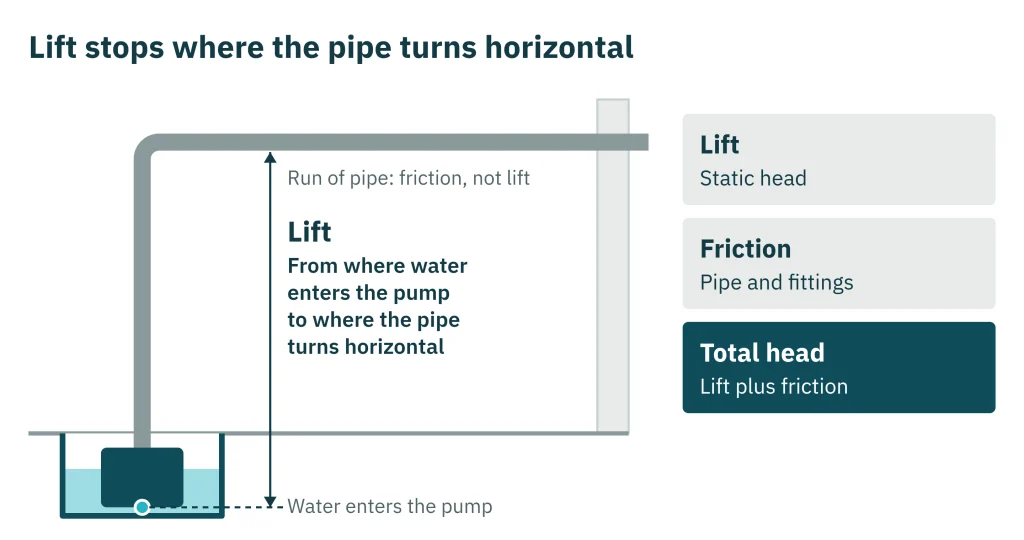
The method, from Friend and Zoeller, is friction head = (fittings’ equivalent length + horizontal pipe length) × loss per 100 ft ÷ 100. Zoeller’s published figures for three pipe sizes are below. This example is Friend’s: 18 gpm, a 13 ft lift, 100 ft of horizontal pipe, three 90-degree elbows and one check valve.
| Pipe | Each 90° elbow | Check valve | Loss per 100 ft at 18 gpm | Friction head | Total head | M53 at that head |
|---|---|---|---|---|---|---|
| 1-1/4 in | 3.5 ft | 11.5 ft | 5.25 ft | 6.4 ft | 19.4 ft | 0 gpm, past its maximum head |
| 1-1/2 in | 4 ft | 13.4 ft | 2.41 ft | 3.0 ft | 16.0 ft | about 14.5 gpm |
| 2 in | 5.2 ft | 17.2 ft | 0.72 ft | 1.0 ft | 14.0 ft | about 22 gpm |
The same pump misses 18 gpm on the 1-1/2 in line and clears it on the 2 in line. The 1-1/4 in row is only a comparison, because the code doesn’t allow a pipe narrower than a 1-1/2 in pump outlet (see below). These methods count only horizontal pipe, and vertical pipe has friction too, so we’d treat the total as a low estimate. As a check on the loss figures, an undated North Carolina health department table built on the Hazen-Williams formula gives 2.84 ft per 100 ft for 1-1/2 in Schedule 40 at 20 gpm, against Zoeller’s 2.96.
How much margin to allow
None of the primary sources we read gives a margin. Friend says to choose a pump that meets system capacity at the head, and adds no multiplier. Online calculators and seller guides we saw offer figures from about 1.2 to 2 times inflow, and they don’t agree. We found no standard behind any of them. So the calculator shows you the gap and leaves the choice to you.
A single test can’t settle it. It measures one storm, and a bigger one may bring more water. Low voltage or a partly blocked line can also cut what a pump moves, Zoeller’s troubleshooting chart shows. Our suggestion is to take the test more than once, in the worst weather you see, and to ask the maker or a plumber what they would allow for your lift and pipe.
Going far bigger has its own cost. Friend says a pump that’s too powerful short-cycles, which can cause early failure. Pentair says too much horsepower can move water too fast in the pipe, so that when the pump stops the column slams down and the check valve bangs shut. Short cycling depends on basin diameter and the on/off range, Zoeller says, and it points to a long-cycle kit, an adjustable switch or a check valve as fixes. No source we read says how many cycles are too many. Our cycle and running cost calculator shows what yours works out to, without a limit.
What the code says
The 2024 International Residential Code is a model code, so check what your city or state has adopted. We read the current version on the ICC site on 4 November 2026.
- Pump size (P3303.1.1): no number, just a pump of a capacity and head “appropriate to anticipated use requirements”. That wording is why a measured inflow helps.
- Pit (P3303.1.2): at least 18 in across and 24 in deep unless otherwise approved, accessible, with a removable cover and a solid floor.
- Check valve (P3303.1.4): discharge piping includes an accessible full-flow check valve.
- Discharge pipe size (P3303.1.4): pipe and fittings the same size as the pump’s discharge tapping, or larger. A 1-1/2 in outlet takes 1-1/2 in pipe or bigger.

Zoeller’s FAQ calls a check valve recommended but not required on non-sewage submersibles. Where the IRC is adopted, the code text comes first. Whether swapping a pump for a larger one needs a permit varies from place to place, so ask your building department.
Before you buy a bigger pump
A high reading is a reason to ask why so much water reaches the basin, and that comes first. University of Minnesota Extension puts interior moisture, then grading and gutters ahead of drainage work. Building Science Corporation says to look above grade first, that fixing wetness without fixing surface drainage may be futile, and that roof runoff must never feed the foundation drain. If the rate jumps within minutes of hard rain, roof or surface water is worth checking before you change the pump (that’s our reasoning, not a test result). Our guide to working out why a basement leaks takes you through it in order.
If the pump runs without stopping, it may not be a size problem at all. A stuck float does the same thing, so go through why a sump pump keeps running first.
A larger pump also needs a place to send the extra water. Don’t discharge to a sanitary sewer or floor drain, and check with your city. Bans are local: Manville, New Jersey requires a certificate at sale or rental, and Tyler, Minnesota adds a monthly surcharge for violations. Michigan’s guidance prefers returning sump water to the ground where it can soak in, without affecting neighbors or causing erosion or ponding. Pipe it far enough out that it doesn’t run back to the foundation, because Building Science Corporation warns it can recycle through the drain.
Electrical work stays with a licensed electrician. Ann Arbor’s sheet says makers recommend plugging directly into an outlet, with no extension cord and nothing else on that circuit. The 2024 IRC requires GFCI protection on basement receptacles and lists sump pumps among the appliances whose outlet or circuit needs it (E3902.5 and E3902.12), so check your local adoption. A GFCI that trips is reporting a fault or leakage it detected: don’t remove or bypass it, and have an electrician check the pump, cord and circuit. Because a tripped GFCI stops the pump, a high-water alarm or battery backup is the protection.
Check your backup pump too
FEMA’s urban flooding guide says sump pumps aren’t designed for large water volumes and don’t work without power, and it suggests battery storage or a generator for outages. CPSC’s rule for a portable generator is never in a basement, and at least 20 feet from the house. Your inflow matters here as well, because backup pumps list their own flows. Zoeller’s Aquanot Spin 508 lists 35 gpm at 10 ft on a 12.7 V battery, and Wayne’s WSM3300 lists 2,300 gallons per hour, or 38.3 gpm, at the same height. Put your inflow into the battery backup run time calculator to see how long a charge may last.
Sources and notes
Lowest Floor sells and installs nothing and refers no one. Models are named from their makers’ own sheets as examples, and we don’t rank them. Friend’s test comes to us through a trade magazine, and the fitting and friction figures are from a maker’s web page, so treat them as a good guide and not as a standard. Curves change between model years: go by the sheet for your exact pump.
This page is general information, not engineering, legal, insurance or medical advice. The pump’s maker, your plumber, electrician, city and insurer decide what applies to your house.
Sources checked on 4 November 2026.
Formulas and sources
- Gallons per inch of rise: NIST Handbook 44, 2026, Appendix C: 1 US gallon = 231 cubic inches
- Gallons collected in the test: Duane Friend, University of Illinois Extension: Sizing Up a Sump Pump, WATERPROOF! magazine, 15 Apr 2013
- Inflow, gallons per minute: Duane Friend, University of Illinois Extension: Sizing Up a Sump Pump, WATERPROOF! magazine, 15 Apr 2013
- Inflow, gallons per hour: Duane Friend, University of Illinois Extension: Sizing Up a Sump Pump, WATERPROOF! magazine, 15 Apr 2013
- Your pump flow minus inflow: Duane Friend, University of Illinois Extension: Sizing Up a Sump Pump, WATERPROOF! magazine, 15 Apr 2013
- Zoeller M53 flow at this head: Zoeller catalog FM0532 (03/24), sump pump performance table
- Zoeller M53 flow minus inflow: Zoeller catalog FM0532 (03/24), sump pump performance table
- Zoeller M98 flow at this head: Zoeller catalog FM0532 (03/24), sump pump performance table
- Zoeller M98 flow minus inflow: Zoeller catalog FM0532 (03/24), sump pump performance table
- Wayne CDU980E flow at this head: Wayne CDU980E product page, performance table
- Wayne CDU980E flow minus inflow: Wayne CDU980E product page, performance table
- Cubic inches in a US gallon (231, as of 2026-01-01): NIST Handbook 44, 2026, Appendix C: 1 US gallon = 231 cubic inches
- Zoeller M53 gpm at 5 ft (43, as of 2024-03-01): Zoeller catalog FM0532 (03/24), sump pump performance table
- Zoeller M53 gpm at 10 ft (34, as of 2024-03-01): Zoeller catalog FM0532 (03/24), sump pump performance table
- Zoeller M53 gpm at 15 ft (19, as of 2024-03-01): Zoeller catalog FM0532 (03/24), sump pump performance table
- Zoeller M53 maximum head, ft (19.25, as of 2017-01-01): Zoeller Model 53 data sheet FM2958: Max. Head 19.25 ft
- Zoeller M98 gpm at 5 ft (72, as of 2024-03-01): Zoeller catalog FM0532 (03/24), sump pump performance table
- Zoeller M98 gpm at 10 ft (61, as of 2024-03-01): Zoeller catalog FM0532 (03/24), sump pump performance table
- Zoeller M98 gpm at 15 ft (45, as of 2024-03-01): Zoeller catalog FM0532 (03/24), sump pump performance table
- Zoeller M98 gpm at 20 ft (25, as of 2024-03-01): Zoeller catalog FM0532 (03/24), sump pump performance table
- Wayne CDU980E gallons per hour at 5 ft (5245, as of 2026-11-04): Wayne CDU980E product page, performance table
- Wayne CDU980E gallons per hour at 10 ft (4743, as of 2026-11-04): Wayne CDU980E product page, performance table
- Wayne CDU980E gallons per hour at 15 ft (4240, as of 2026-11-04): Wayne CDU980E product page, performance table
- Wayne CDU980E gallons per hour at 20 ft (3571, as of 2026-11-04): Wayne CDU980E product page, performance table
Sources
- 2024 International Residential Code, chapter 33: P3302 and P3303
- Duane Friend, University of Illinois Extension: Sizing Up a Sump Pump, WATERPROOF! magazine, 15 April 2013
- Zoeller at Home: 5 Steps to Sump Pump Sizing
- Zoeller catalog FM0532, March 2024
- Zoeller Model 53 data sheet FM2958, 2017
- Zoeller Aquanot Spin instructions FM3167, March 2026
- Zoeller product support FAQ
- Wayne CDU980E product page
- Wayne WSM3300 product page
- 2024 International Residential Code, Appendix BE: radon control methods
- 2024 International Residential Code, chapter 39: E3902.5 and E3902.12
- NIST Handbook 44, 2026, Appendix C
- North Carolina DPH: Friction Loss Through 100 Feet of Plastic Pipe
- City of Ann Arbor: Sump Pump 7 Causes of Failure
- Pentair: sump pump troubleshooting FAQ
- Ferguson Home: How to Pick the Perfect Submersible Sump Pump
- University of Minnesota Extension: Moisture in basements
- Building Science Corporation: BA-1015 Bulk Water Control
- FEMA: Urban Flooding, Guidance for Homeowners and Renters, Nov 2024, rev. May 2025
- CPSC: flood safety release on generators and carbon monoxide, 2023
- Iowa HHS: FAQ About Cleaning Flooded Basements, 23 June 2024
- Michigan EGLE: sump pump discharge guidance, January 2022
- Manville, NJ: Ordinance 2020-1233, sump pump connection inspection (archived copy)
- Tyler, MN: sanitary sewer inflow and infiltration ordinance, amended 5 June 2023